

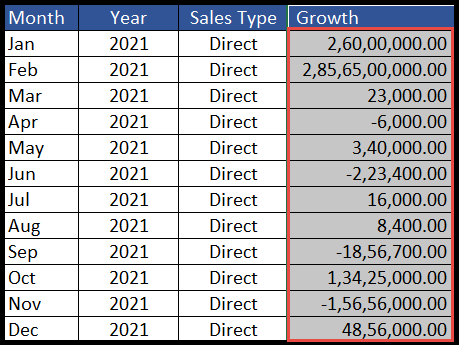
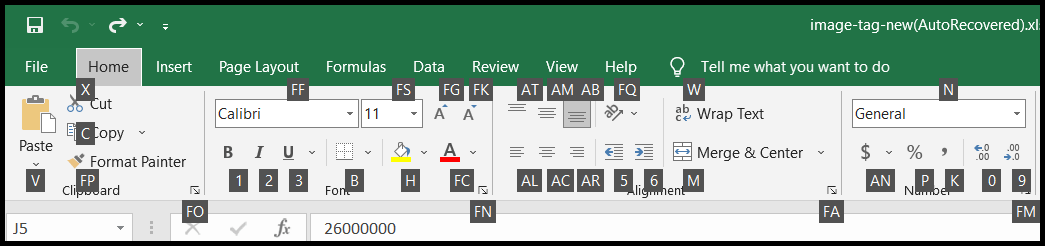
Select the numbers and click the comma icon in Home → Number, or press Alt → H → K. Comma Style adds thousands separators and two decimals, like 1,234,567.00, without a currency symbol.
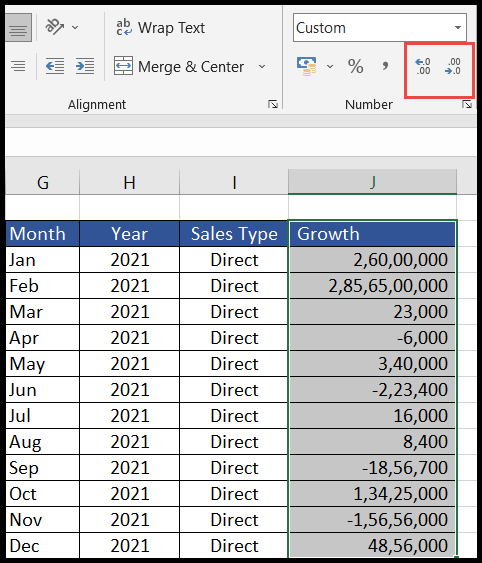
Use Home → Decrease Decimal to drop the decimals. For separators without Comma Style’s other changes, press Ctrl + Shift + ! for #,##0.00, or enter #,##0 under Ctrl + 1 → Custom.
Comma Style shows zeros as a dash and indents numbers slightly from the cell edge, because it’s the Accounting format without the symbol. That’s expected, not an error.
Whether you see 12,34,567 (lakhs) or 1,234,567 (millions) depends on the digit grouping in your Windows region settings, not on Excel. Change it under Control Panel → Region → Additional settings and restart Excel. To force lakh grouping in one workbook instead, use the custom format [>=10000000]##,##,##,##0;[>=100000]##,##,##0;##,##0 for positive numbers.
The comma style in Excel is also known as the thousand separator format that shows large numbers with commas inserted as separators, so you can easily read them in thousands, hundred thousands, millions, and so on.
When you apply the comma style, it also adds two decimal places to the numbers. So, in short, it works like the accounting number format, but it doesn’t add a currency symbol to the number, which the accounting format does. Like the accounting format, it shows zeros as a dash and negative numbers in parentheses.
The comma style can show the numbers separated in lakhs or in millions, depending on the region and number format settings of your system, but you can change it from lakhs to millions and vice versa.
For example, India groups numbers in lakhs and crores, while the USA groups them in millions. We have quick and easy steps mentioned below for you to apply comma style in Excel.
Apply Comma Style Using the Home tab
- First, select the cells or range of cells or the entire column where to apply the comma style.

- After that, go to the “Home” tab and click on the comma (,) icon under the “Number” group on the ribbon.

- Once you click on the comma (,) icon, comma separators are applied to the numbers in your selected range.
To increase or remove the decimal places, simply select the range and then click on the “Increase Decimal” or “Decrease Decimal” button in the same “Number” group on the ribbon.
Apply Comma Style Using Format Cells Option
- First, select the cells or range of cells or the entire column where to apply the comma style.
- After that, right-click and select the “Format Cells” option from the menu (or press Ctrl + 1).
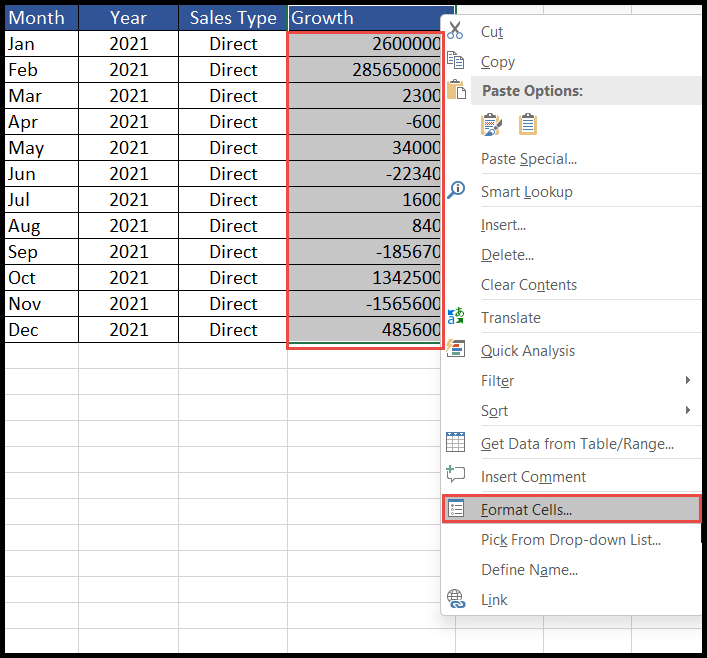
- Once you click on “Format Cells”, the “Format Cells” dialog box opens.
- Now, on the “Number” tab, select the “Number” category and then tick the “Use 1000 Separator (,)” box.
- In the end, click OK, and comma separators are applied to the numbers in your selected range.
- To remove the decimal values, enter zero (0) in the “Decimal places” field.
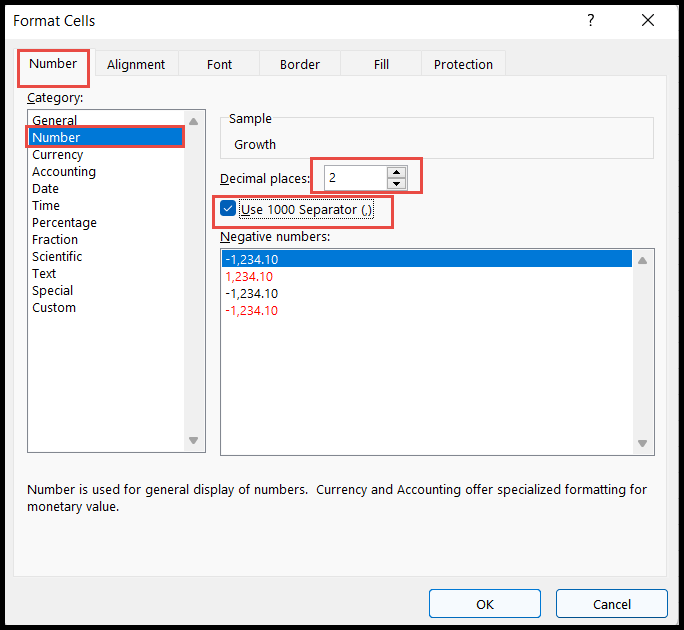
This method doesn’t give exactly the same result as the comma button. The Number format with the 1000 separator shows zeros as 0.00 and negatives with a minus sign, while the comma style shows zeros as a dash and negatives in parentheses.
Change the Comma Style Separators from Lakhs to Million format
Sometimes, comma separators show numbers separated in lakhs due to the default region and number format of your system, but you can change it to the millions format by following the below steps:
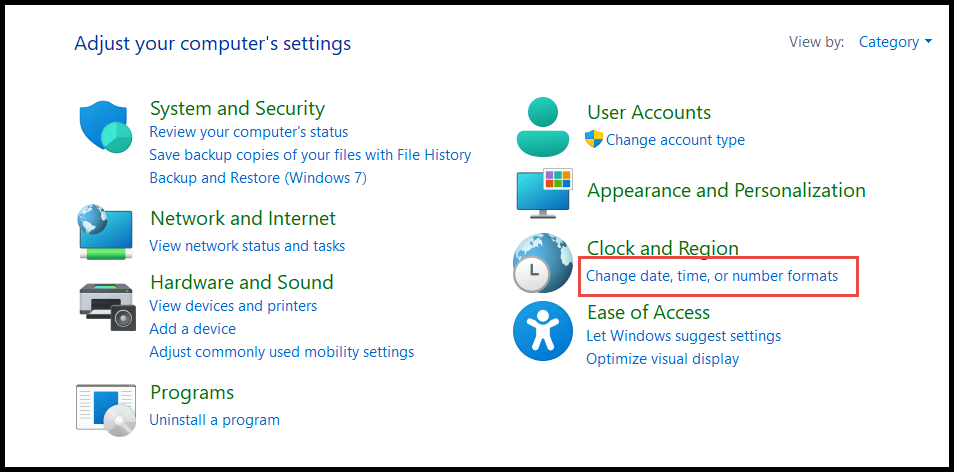
- First, go to your system “Control Panel” and click on the “Change date, time, or number formats” link under the “Clock and Region” or “Region and Language” option. (Option names could be different depending on the Windows version)
- After that, click on “Additional Settings” within the “Region” dialog box.
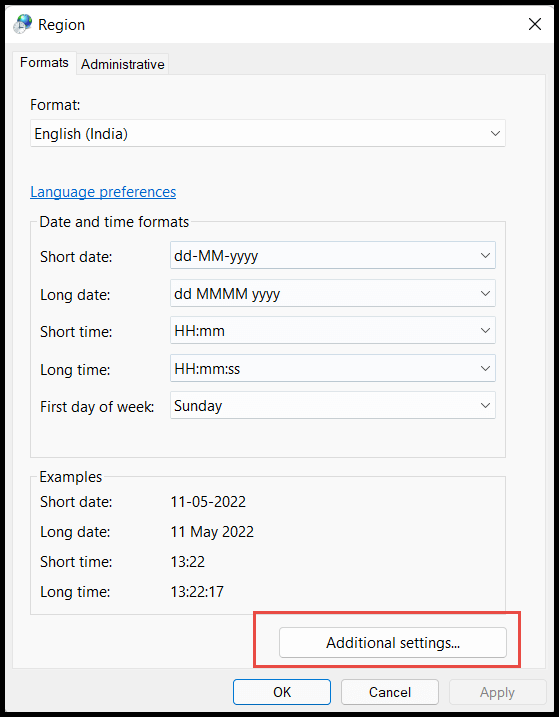
- Once you click on “Additional Settings”, you will get the “Customize Format” dialog box opened.
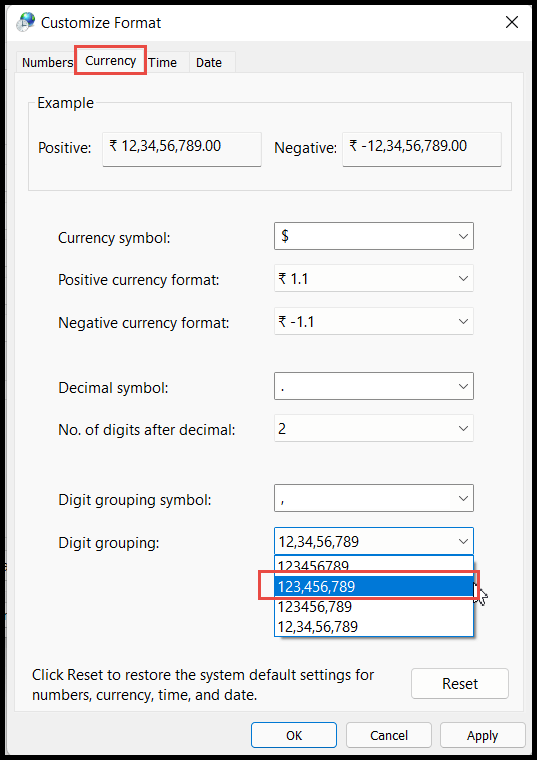
- Now, on the “Numbers” tab, select the millions style (123,456,789) in “Digit grouping”. Do the same on the “Currency” tab if you also use currency formats.
- In the end, click Apply and then OK in the “Customize Format” dialog box, and then in the “Region” dialog box.
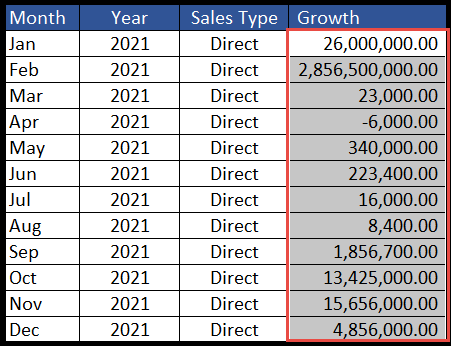
- Once you are done, close and reopen Excel and apply the comma style, and the separators in your selected range will be in thousands, hundred thousands and millions.
Apply Comma Style Using Keyboard Shortcut
Select the entire column or the range where you want to apply the comma style, and then press the Alt+ H + K keys one after another, and the comma style is applied to your selected range.
Show Lakhs and Crores without Changing Windows Settings
If your system uses the millions format but you want Indian-style separators only in one workbook, use a custom number format instead. Press Ctrl + 1, go to Number ➜ Custom, and enter the following code in the Type box. It shows 123456789 as 12,34,56,789:
[>=10000000]##\,##\,##\,##0;[>=100000]##\,##\,##0;##,##0
This code is for positive whole numbers. As it uses conditions, it doesn’t have separate sections for negative numbers and zero.
Frequently Asked Questions
How do I remove the comma style?
Select the cells and choose General from the Number Format drop-down on the Home tab, or press Ctrl + Shift + ~. You can also go to Home ➜ Cell Styles and pick Normal.
Why does comma style show a dash for zero?
Because the comma style uses the accounting layout without a symbol, and that layout shows zeros as a dash. Use the Number format with the 1000 separator if you want to see 0.00.
How do I apply comma style without decimals?
Apply the comma style and click Decrease Decimal twice on the Home tab. Or, in Format Cells, set Decimal places to 0.

Written by
Puneet Gogia
Microsoft MVP — Excel · Founder, Excel Champs
Twelve years of teaching Excel, and a decade before that using it as a data analyst. Every tutorial here is written from a file I actually built.