

Excel stores time as a fraction of a day, so converting minutes means dividing by 1440 — the minutes in a day — then formatting the result: =A1/(24*60), then Ctrl+1 → Custom and enter [h]:mm. The square brackets matter: without them, anything over 24 hours wraps around, so 1500 minutes shows as 1:00 instead of 25:00.
The TEXT function does both steps at once if you’d rather not change the cell format: =TEXT(A1/(24*60),"[h]:mm"), though the result is text and can’t be summed afterwards.
For a plain decimal number instead of a time value, divide by 60: =A1/60 turns 90 minutes into 1.5 hours — useful for timesheets and billing, and note the .5 is half an hour, not fifty minutes. =CONVERT(A1,"mn","hr") gives the same decimal result.
And to split the total into separate whole numbers, use =INT(A1/60) for the hours and =MOD(A1,60) for the leftover minutes.
To convert minutes to hours and minutes (HH:MM) in Excel, you need to use a formula where you divide the number of minutes by (24*60). As (24*60) is the total number of minutes in a day, it returns a number with decimals, which is the part of a day those minutes make (150 minutes is 0.104 of a day).
For converting that number into hours and minutes format, you need to apply [h]:mm in the custom formatting.

Formula to Convert Minutes into Hours and Minutes
You can use the below steps:
- First, in cell B1, refer to cell A1 where you have the minutes value.
- After that, type the division operator, and then enter an opening parenthesis.
- Now, enter 24, and then enter the multiply operator.
- Next, enter 60, close the parenthesis, and hit Enter to get the result.
Once you hit Enter, you will get the minutes as a part of a day in the cell (like 0.104166667 for 150 minutes).

The next thing is to change the format of the cells. For this, select the cell and open the Format Cells dialog box using the keyboard shortcut Ctrl + 1.
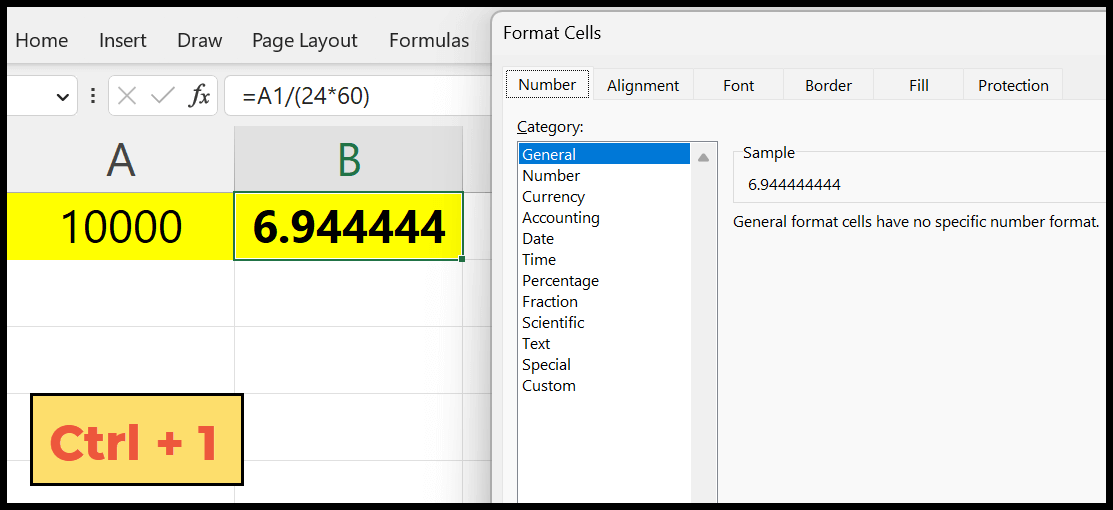
Now from here, click on the Custom category, and enter the format [H]:mm into the Type box.

In the end, click OK to apply the format.
=A1/(24*60)
With [H]:mm, 150 minutes shows as 2:30. The square brackets around h let the hours go past 24, so 1530 minutes shows as 25:30. With h:mm (no brackets), it would show 1:30, as Excel drops the full day.
How does this Formula work?
In this formula, we have used 24*60 which returns the total number of minutes in a day (24 hours X 60 minutes = 1440 minutes).
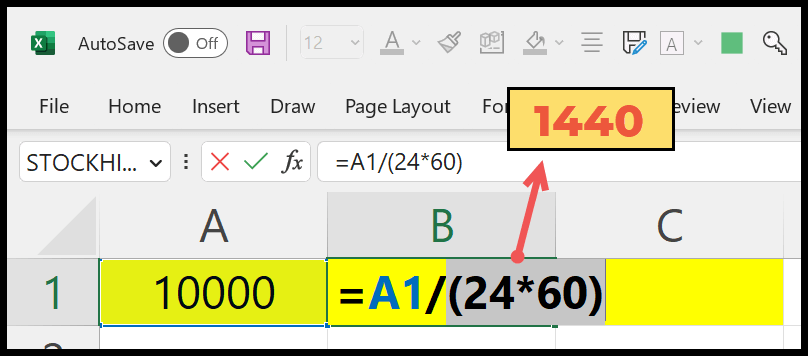
After that, when you divide the number of minutes you have by it, it returns the days, which is equivalent to the number of minutes that you have.

Now, to show these days as hours and minutes, you need to use the [h]:mm format.
Using TEXT Function
If you don’t want to change the formatting of the cell, you can use the TEXT function to apply the time format to the value within the formula.

This formula exactly works like the earlier method. The only difference is that you are using TEXT to format the result value.
=TEXT(A1/(24*60),"[h]:mm")
Keep in mind that TEXT returns text, so you can’t add up these results with SUM.
Convert Minutes to Hours and Minutes (As a Number)
You can also use a formula where you divide the number of minutes by 60.
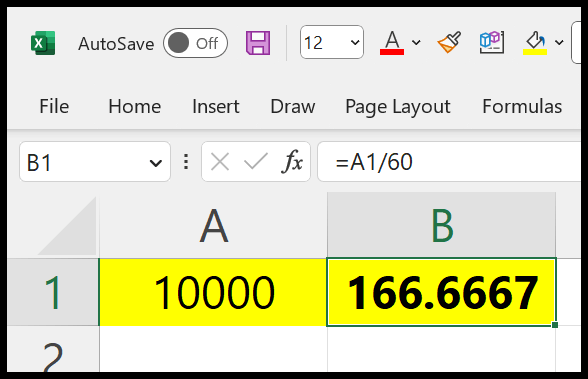
This formula returns the hours as a decimal number, where the whole number is the hours and the decimal part is a fraction of an hour, not minutes. For example, 150 minutes returns 2.5, which is 2 hours and 30 minutes.
=A1/60
Convert Function
There’s one more function in Excel that you can use to convert minutes to hours, and that’s CONVERT.

In CONVERT, you need to refer to the minute value, the original unit of the value (you need to specify minutes “mn”), and then the conversion unit (specify “hr” for hours).
=CONVERT(A1,"mn","hr")
Like dividing by 60, CONVERT returns decimal hours (2.5 for 150 minutes).
Show Hours and Minutes as Words
If you want a result like “2 hours 30 minutes”, use INT to get the full hours and MOD to get the minutes left over:
=INT(A1/60)&" hours "&MOD(A1,60)&" minutes"
Convert Hours and Minutes Back to Minutes
To go the other way, multiply a time value (like 2:30 in A1) by 1440, the number of minutes in a day, and format the result as General:
=A1*1440
Frequently Asked Questions
Why does my result show 1:30 instead of 25:30?
The cell uses h:mm, which resets after 24 hours. Use [H]:mm with the square brackets to show the total hours.
Can I add up the converted times?
Yes, if you used the =A1/(24*60) formula with the [H]:mm format. SUM adds them, and you should format the total with [H]:mm too. Results from TEXT are text and can’t be added.
What is 1440 in Excel time formulas?
It’s the number of minutes in a day (24 × 60). Dividing minutes by 1440 gives Excel’s time value, and multiplying a time by 1440 gives minutes.
Written by
Puneet Gogia
Microsoft MVP — Excel · Founder, Excel Champs
Twelve years of teaching Excel, and a decade before that using it as a data analyst. Every tutorial here is written from a file I actually built.