

To convert a time into seconds, multiply it by 86400 — the number of seconds in a day: =A1*86400. Excel stores time as a fraction of a day, so 6:30:00 is 0.27083 and multiplying it scales it back to 23,400 seconds.
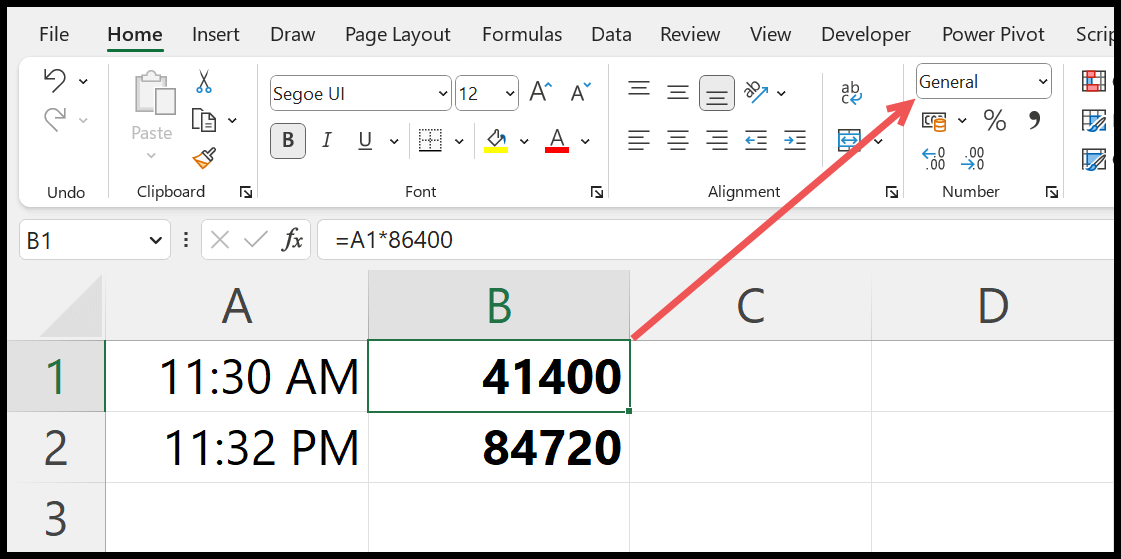
The result cell needs to be formatted as General or Number, otherwise it inherits the time format from the source and shows something odd rather than the number you want.
This works the same on a total: if you’ve summed several times, multiply that sum by 86400 as usual — but the summed cell must be formatted as [h]:mm:ss, since a total over 24 hours wraps around otherwise and you’d be converting the wrong value.
The alternative is =HOUR(A1)*3600+MINUTE(A1)*60+SECOND(A1), which reads more clearly but only works up to 24 hours, because HOUR resets after that. To go the other way, divide by 86400 and format the cell as time.
To convert a time in Excel into seconds, you need to multiply that value by 86400. This is the total number of seconds that we have in a single day, and Excel stores time as decimals (1 is equivalent to 24 hours). Now when you multiply time by the total number of seconds, it returns the number of seconds according to that time.

Formula to Convert Time to Seconds
You can use the below steps:
- First, enter the equal to (=) operator.
- Next, refer to the cell where you have the time value.
- Now, enter the asterisk to multiply.
- After that, enter 86400.
- In the end, hit enter to get the result.

=A1*86400Once you enter the above formula in a cell you need to have the cell format as “General“, so that you can have the number value in the cell.
Convert Total Time into Seconds
If you have a time value that is the total of multiple time values, you can still use the same formula.
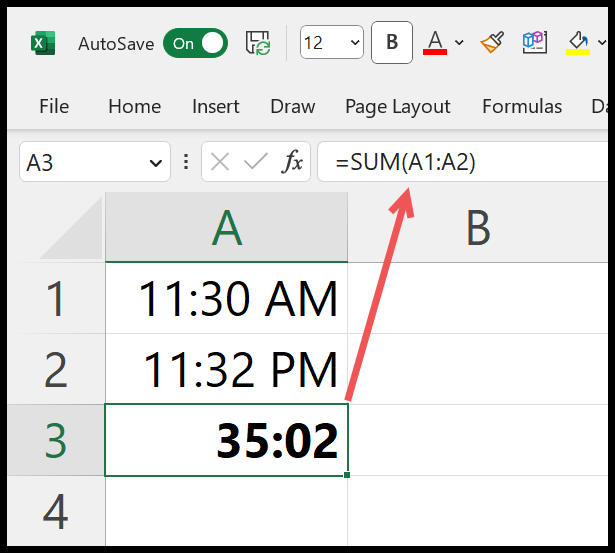
In cell A3, we have the sum and in cell A5, we have used the same formula to get the total seconds from the time value.

Written by
Puneet Gogia
Microsoft MVP — Excel · Founder, Excel Champs
Twelve years of teaching Excel, and a decade before that using it as a data analyst. Every tutorial here is written from a file I actually built.