

To add hours to a time, divide the hours by 24 and add: =A1+(3/24) adds three hours. The TIME function does it without the arithmetic: =A1+TIME(3,0,0).
To subtract, use a minus sign. Two things to watch.
If the total passes midnight, plain addition rolls into the next day and displays only the time part — use =MOD(A1+(3/24),1) to wrap it, or format as [h]:mm if you want to see the full elapsed total past 24 hours.
And TIME’s hour argument caps at 32767 and rolls over above 23, so TIME(25,0,0) gives 1:00 AM rather than 25 hours — for large hour values the division method is the reliable one.
To add an hour value into a time value in Excel, you can use a simple and short formula where you need to specify the original time from a cell and the hour(s) value that you want to add after dividing it by 24 (which is the total number of hours in a day). The following example shows a time value in cell A1 (12:01 AM), and here you need to add 3 hours.


Formula to Add Hours in a Time
Here are the steps that you can use to add hours to a time:
- First, refer to the cell where you have the time value (A1 in our example).
- After that, enter the plus operator (+) and type an opening parenthesis.
- Next, enter the hour value you want to add to the original time.
- Now, enter a division operator and type 24, the total number of hours in a day.
- Finally, type a closing parenthesis and hit Enter to get the result value.
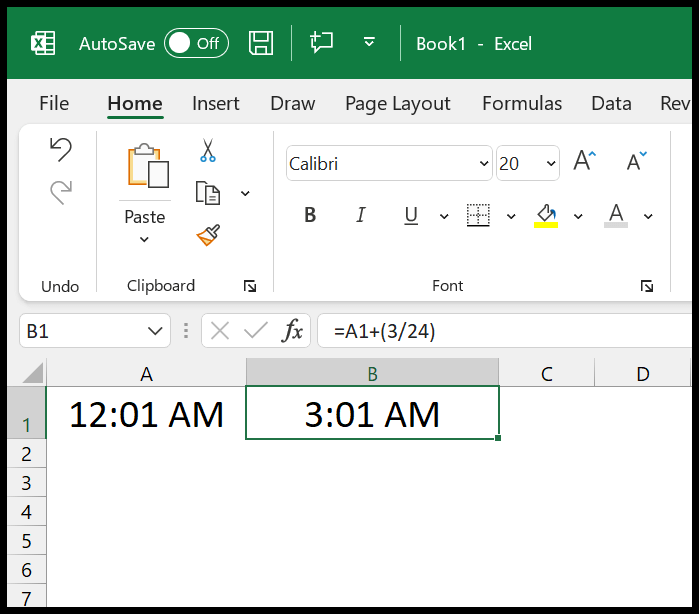
=A1+(3/24)
The formula is quite simple. You specify the original time and then add the hour value divided by 24. For 12:01 AM, it returns 3:01 AM.
Use Time Function to Add Time
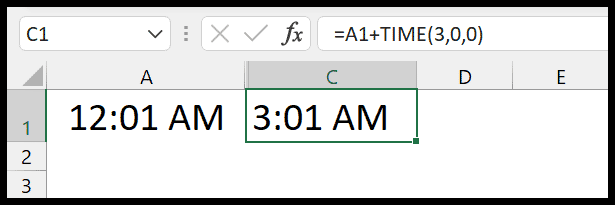
You can also use the TIME function to add hours to a time value. You can see this in the following formula.
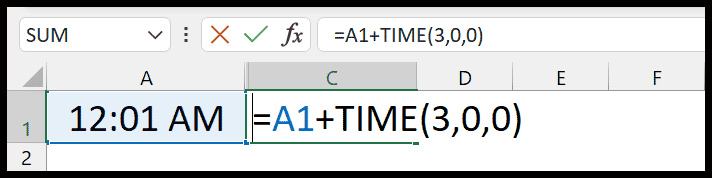
You need to specify the original time, use the TIME function, and only specify the hour argument with the hours you want to add (and 0 for minutes and seconds).
=A1+TIME(3,0,0)
With TIME, you can also add hours and minutes together. For example, =A1+TIME(3,30,0) adds three and a half hours.
But TIME can’t add 24 hours or more: its hour argument starts again after 23, so TIME(25,0,0) is the same as 1:00 AM. For more than 24 hours, use the division formula (like =A1+30/24) instead.
Add Hours from Another Cell
If the number of hours is in a cell (B1), divide that cell by 24. You can then drag the formula down for a whole list:
=A1+B1/24
When the Result Goes Past Midnight
If you add 3 hours to 10:00 PM, the result is 1:00 AM of the next day. The cell holds 1.0417 (one day and one hour), and with a time format, you see only 1:00 AM. To keep only the time part, wrap the formula in MOD:
=MOD(A1+(3/24),1)
And if the cell has a date and time, the same formula =A1+(3/24) also moves the date forward when it passes midnight.
Subtract Hours from a Time
To subtract hours, use the minus operator. If the result goes before midnight, Excel can’t show a negative time and shows ####, so use MOD here as well (12:01 AM minus 3 hours returns 9:01 PM):
=MOD(A1-(3/24),1)
Frequently Asked Questions
Why does my result show as a decimal number?
The result cell has the General format. Apply a time format like h:mm AM/PM to the cell.
Why do I get ##### after subtracting hours?
The result is a negative time, which Excel can’t show. Use the MOD formula shown above.
How do I add hours to a total of more than 24 hours?
Use the division formula and apply the custom format [h]:mm to the cell, so the hours keep counting past 24.
Written by
Puneet Gogia
Microsoft MVP — Excel · Founder, Excel Champs
Twelve years of teaching Excel, and a decade before that using it as a data analyst. Every tutorial here is written from a file I actually built.