

To divide in Excel, use the forward slash: =A1/B1 divides the value in A1 by the value in B1, and =100/5 returns 20 if you’d rather type the numbers in. There’s no DIVIDE function — the slash is the operator.
To divide a whole column, enter the formula in the first row and drag down, or press Ctrl+D after selecting the range. In Excel 365 you can do the whole column with one formula: =A2:A20/B2:B20 spills the results down automatically.
Two things to know. If the divisor is empty or zero you get #DIV/0!, since Excel treats a blank as zero — guard against it with =IFERROR(A1/B1,"") or, more precisely, =IF(B1=0,"",A1/B1).
And if you want the whole-number part only, without decimals, use =QUOTIENT(A1,B1), which returns 3 for 10 divided by 3; =MOD(A1,B1) gives you the remainder.
In Excel, there are multiple ways to divide numbers. There’s a simple way to do this with the divide operator, and another way is to use the QUOTIENT function. In this tutorial, we are going to learn both methods in detail.
Using the DIVIDE Operator in Excel (Basic Divide Formula)
You can use the below steps:
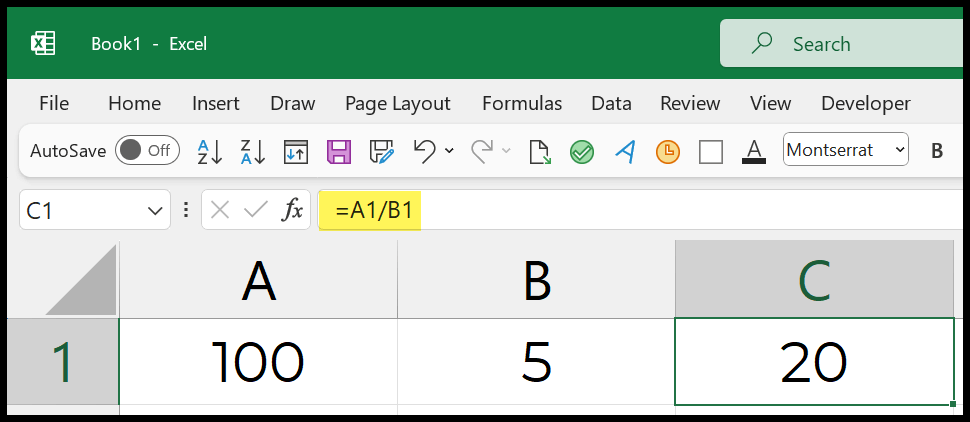
- First, enter (=) in a cell to start the formula.
- After that, refer to the cell with the dividend.
- Next, enter the “/” divide operator.
- Now, refer to the cell with the divisor.
- In the end, hit enter to get the result.
You can see in the below example, where we have 100 (dividend) and 5 (divisor).

When you hit enter, it returns 20 in the result.
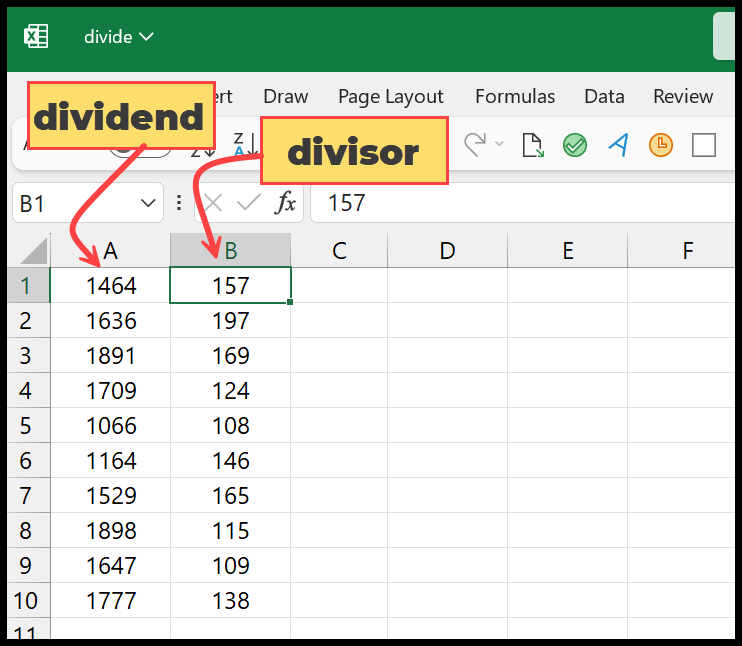
- dividend – A number that you want to divide.
- divisor – A number that we are dividing the dividend with.
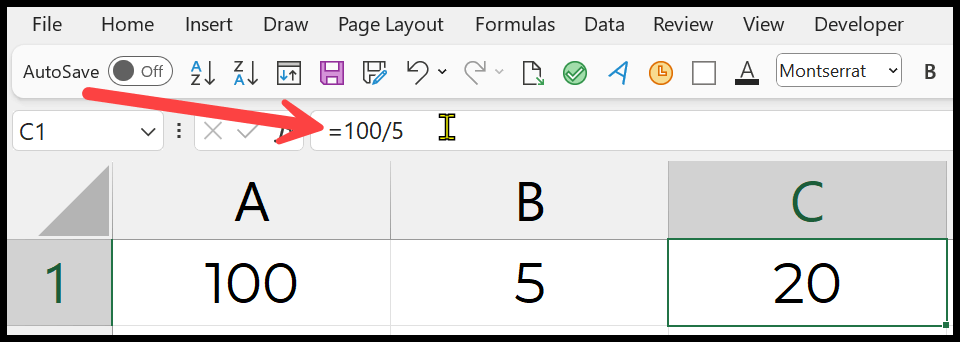
You can also input numbers directly into the formula instead of referring to the cells.
=A1/B1
= dividend/divisor
=100/5
Divide Columns in Excel
Now, let’s say you have two columns in a sheet, and you are required to divide the corresponding values of columns.
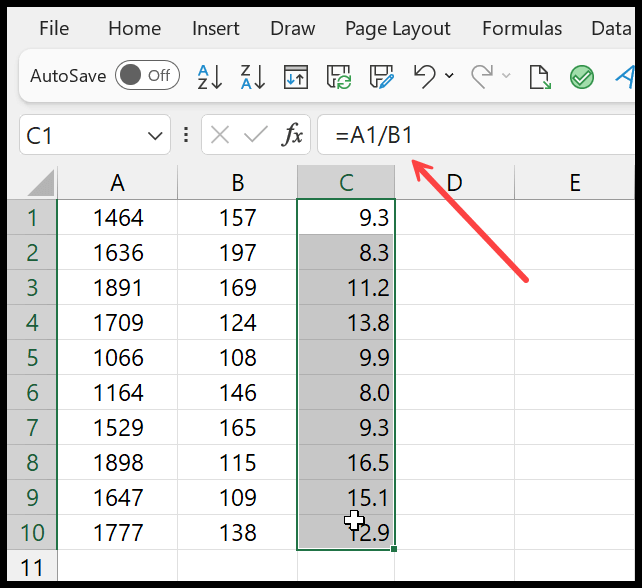
- In column C, enter the formula for the first entry (=A1/B1).
- After that, hit enter to get the result.
- Now, use your mouse to drag the formula down to the last cell in the column, or select the cells and use the keyboard shortcut Ctrl + D.
Use Array Formula to Divide Columns
If you want to enter one formula for the entire column in one go, you can use an array formula.
- Select the cells of the column where you want the results.
- Enter (=) and refer to the dividend column.
- After that, enter the (/) divide operator.
- Next, refer to the divisor column.
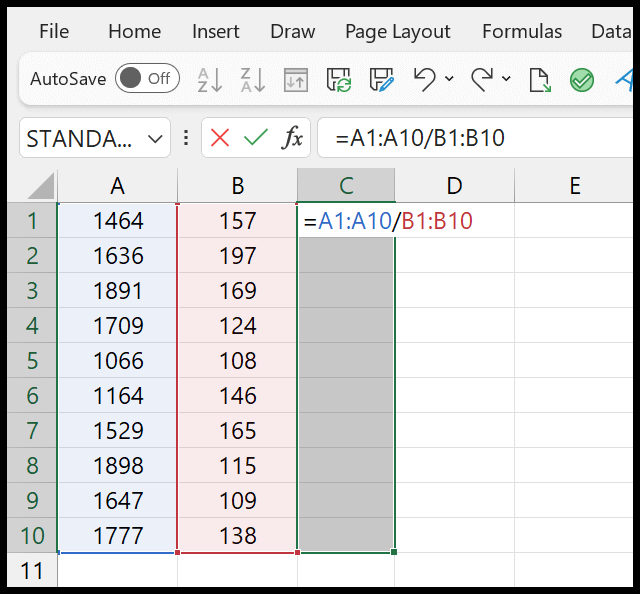
In Excel 2019 and older versions, you must use Ctrl + Shift + Enter to enter the formula as an array formula. So, hold Ctrl and Shift and then hit Enter to apply the formula. In Excel 2021 and Microsoft 365, you just type =A1:A10/B1:B10 in the first cell and press Enter, and the results spill down to the cells below on their own.
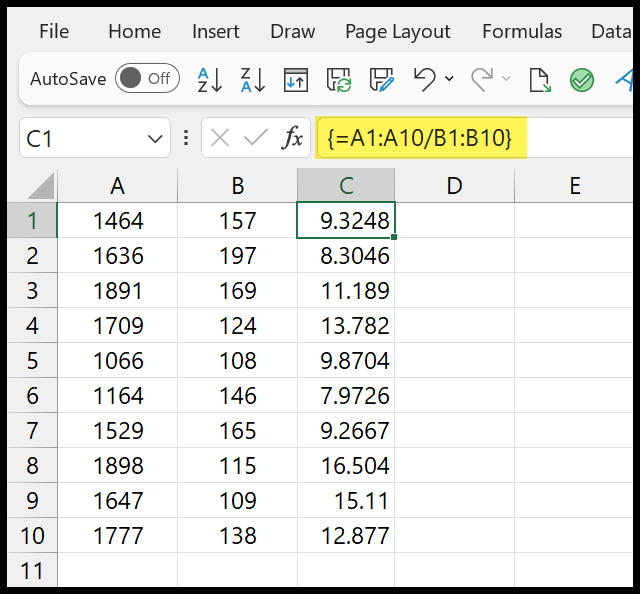
When you enter an array formula in a range of cells, you can’t change the formula in a single cell of that range.
A Problem You Might Face
When you divide two numbers and the divisor is zero (or a blank cell), you get the #DIV/0! Error in the result. And if the dividend is 0, the result will be 0.
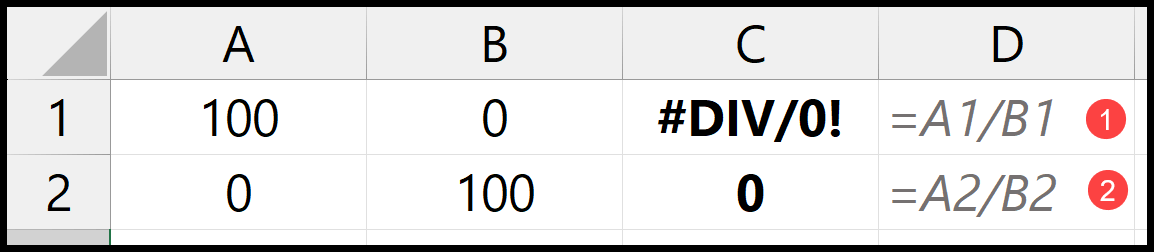
The best way to deal with this problem is to verify the values when you get an error in the result. In this tutorial, the #DIV/0! Error is explained in detail.
If a zero divisor is expected (like a month with no sales yet), you can show a blank instead of the error. The first formula checks the divisor before dividing, and the second one returns 0 for any error:
=IF(B1=0,"",A1/B1)
=IFERROR(A1/B1,0)
Use the QUOTIENT Function
QUOTIENT divides two numbers and returns only the integer part of the result, without the remainder. For example, 7 divided by 2 is 3.5, but QUOTIENT returns 3:
=QUOTIENT(A1,B1)
To get the remainder that QUOTIENT leaves out, use the MOD function. For 7 and 2, it returns 1:
=MOD(A1,B1)
Just note that QUOTIENT cuts off the decimals toward zero, so -7 divided by 2 gives -3, while INT(-7/2) gives -4. And if you want a rounded result instead, use ROUND(A1/B1,0).
Divide a Column by the Same Number
When all the values need to be divided by one number in a cell, lock that cell with dollar signs, so it doesn’t change when you drag the formula down:
=A1/$B$1
To divide the values themselves without a formula, use Paste Special:
- First of all, enter the number you want to divide by in a cell and copy it (Ctrl + C).
- After that, select the cells with the values, and press Ctrl + Alt + V to open Paste Special.
- In the end, select Divide under Operation and click OK.
Frequently Asked Questions
Is there a DIVIDE function in Excel?
No. Excel uses the forward slash (/) operator to divide. QUOTIENT is the only function for division, and it returns only the integer part.
How do I divide and show the result as a percentage?
Use the same formula, like =A1/B1, and apply the Percent Style (Ctrl + Shift + %) to the cell. You don’t need to multiply by 100.
Why does my division return #VALUE!?
One of the cells has text that Excel can’t read as a number, like “10 kg” or a space. Remove the extra text, or check the cell with ISNUMBER.
Written by
Puneet Gogia
Microsoft MVP — Excel · Founder, Excel Champs
Twelve years of teaching Excel, and a decade before that using it as a data analyst. Every tutorial here is written from a file I actually built.