

Excel has no CUBEROOT function, so you raise the number to the power of one-third instead. Use =A1^(1/3) or =POWER(A1,1/3) — both return 5 for 125. The parentheses around 1/3 are essential; without them, =A1^1/3 divides the number by 3 instead.
Two things to watch. Negative numbers return #NUM! with either method, even though -125 has a real cube root of -5. The fix is =SIGN(A1)*ABS(A1)^(1/3), which handles positive and negative numbers alike.
And because one-third can’t be stored exactly in binary, some results come back very slightly off — the cube root of 27 may show as 3.0000000000000004 — so wrap it in ROUND if you need a clean figure: =ROUND(A1^(1/3),6).
For Example – A construction manager needs to determine the size of a cubic container that can hold a specific volume of material. By calculating the cube root of the volume in cubic feet, they can quickly find the length of each side of the cube, ensuring they choose a suitable container for storage or transport.
What is CUBE ROOT?
The cube root is a value that, when multiplied by itself three times, equals the original number. For example, the cube root of 27 is 3 because 3×3×3=27. You can calculate the cube root in Excel using the POWER function with 1/3 as the exponent (e.g., =POWER(27, 1/3)) or the caret operator (e.g., =27^(1/3)).
In this tutorial, you will learn both of these methods. And in the end, I have shared code to create a custom function for a cube root.

POWER Function for Cube Root Formula
In Excel, the POWER function raises one number to the power of another. For example, to find the cube root, you can use =POWER(number, 1/3), which means you’re raising the number to the power of one-third.
You need to specify the number for which you want to find the cube root, and for the second argument, you need to specify the power to calculate the cube root (1/3).
=POWER(A1,1/3)
In the following example, we have a number (125) in cell A1, and in cell B1, we have a formula that returns the cube root of 125 (which is 5) as the result.
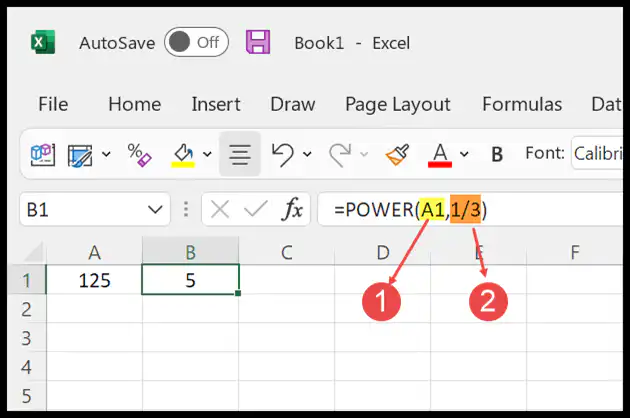
You can see that we have used 1/3 in the power argument, not 3, so that’s one thing that you need to take care of while writing this formula.
And, if you want to calculate the cube root of a negative number, you can use the same function: =POWER(-8,1/3) returns -2 in Excel. But Excel doesn’t accept every fractional power of a negative number: =POWER(-8,2/3), for example, returns the #NUM! error, and VBA and some other spreadsheet apps give an error even for the cube root. If you want a formula that works everywhere, take the cube root of the absolute value and put the sign back with SIGN:
=SIGN(A1)*ABS(A1)^(1/3)
This formula returns -2 for -8, 5 for 125 and 0 for 0, so you can use it for any number.
Cube Root with CARET Operator (^)
Just like POWER, in Excel, the caret (^) operator is used for exponentiation, meaning it raises a number to the power of another number. With the CARET operator, you don’t need to use a function to create a formula.
=A1^(1/3)
- First, enter “=” in a cell.
- Then, specify the number for which you want to calculate the cube root.
- Next, enter the “^” caret operator.
- In the end, use “(1/3)” as the power, but make sure to wrap it in parentheses.
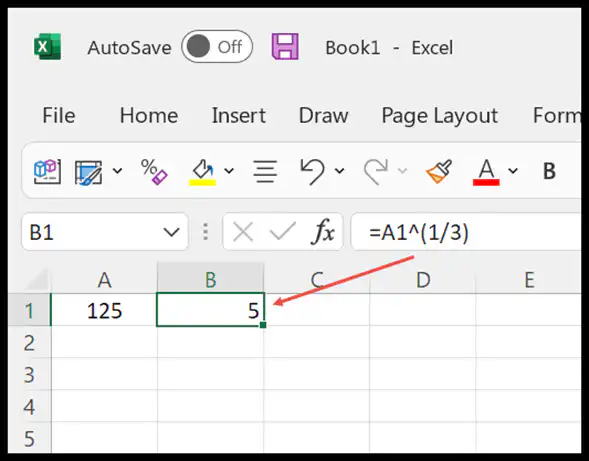
The formula =A1^(1/3) calculates the cube root of the value in cell A1. The parentheses matter: without them, =A1^1/3 raises A1 to the power of 1 and then divides it by 3. The caret operator handles negative numbers the same way as POWER, so =(-8)^(1/3) also returns -2.
Create a Custom Function for Cube Root
If you are familiar with VBA, you can use the code below to create a custom function to get the cube root of a number in Excel.
Function CubeRoot(num As Double) As Double
    CubeRoot = Sgn(num) * Abs(num) ^ (1 / 3)
End Function
=CubeRoot(A1)
You can use this function in Excel by typing =CubeRoot(number) in a cell, where the number is the value at which you want to find the cube root. For example, =CubeRoot(125) will return 5, and =CubeRoot(-8) will return -2. The function uses Sgn and Abs, because num ^ (1 / 3) gives a run-time error in VBA when the number is negative.
To add this code in Excel, first open the Developer tab on the ribbon. You can enable it from Excel Options under the Customize Ribbon section if it’s not visible. Once the Developer tab is active, click the “Visual Basic” button to open the VBA editor. You can insert a new module (Insert ➜ Module) and paste the code into the code window. You can also open the VBA editor with the Alt + F11 keyboard shortcut. Save the file as a macro-enabled workbook (.xlsm) to keep the function.
Calculate Any Root of a Number
The same method works for any root. Divide 1 by the root you need: 1/2 for the square root, 1/3 for the cube root, 1/4 for the fourth root, and so on. For example, the following formula returns the fourth root of the number in A1:
=A1^(1/4)
Check If a Number Is a Perfect Cube
The cube root of most numbers has decimals (the cube root of 10 is 2.1544…). To check if a number is a perfect cube, round its cube root to a whole number, cube it again and compare it with the original. The formula returns TRUE for 27 and FALSE for 10:
=ROUND(A1^(1/3),0)^3=A1
Frequently Asked Questions
Why does my cube root formula return #NUM!?
The cube root of a negative number works in Excel, but a negative number raised to some other fractional powers (like 2/3) returns #NUM!. For those, take the cube root with the SIGN and ABS formula first and then raise it to the next power, like =(SIGN(A1)*ABS(A1)^(1/3))^2 for the power 2/3 (it returns 4 for -8).
Is there a cube root function in Excel?
No. Excel has SQRT for the square root, but there’s no function for the cube root. Use POWER, the caret operator, or the custom VBA function shown above.
Why do I get a #VALUE! error?
The cell has text instead of a number, often a number stored as text. Convert it into a number first (for example, with VALUE or Text to Columns), and the formula will work.
Written by
Puneet Gogia
Microsoft MVP — Excel · Founder, Excel Champs
Twelve years of teaching Excel, and a decade before that using it as a data analyst. Every tutorial here is written from a file I actually built.