

Go to File → Options → General, set Use this as the default font and Font size under When creating new workbooks, click OK and restart Excel. New workbooks then open in that font; files you’ve already saved don’t change.
Current Microsoft 365 uses Aptos Narrow 11 as the default. To go back to Calibri in a workbook, choose Page Layout → Themes → Fonts → Office 2013–2022.
To change the font in the workbook you have open, including existing cells, right-click Normal in Home → Cell Styles, choose Modify → Format and set the font, size and colour. Cells you’ve formatted by hand keep their own font.
Excel Options has no setting for the default font colour. To get a colour, or any other look, in new workbooks, set it in a blank workbook through the Normal style, save it as an Excel Template named Book.xltx in %appdata%MicrosoftExcelXLSTART, and restart Excel. Workbooks you create with Ctrl + N then start from that file.
Start a saved template from File → New → Personal so you get a copy. Opening the .xltx file through File → Open and saving it overwrites the template itself.
In Excel 2021 and earlier versions, Calibri is the default font style, with a font size of 11 and black font color. In Microsoft 365, the default font is now Aptos Narrow, also with a font size of 11, as Microsoft replaced Calibri with Aptos as the default Office font. And on a Mac, it’s the same: Calibri 11 in older versions and Aptos Narrow 11 in Microsoft 365.
But there’s an option in Excel to change the default font style if you want. You can change it for the current workbook, or you can change the default font for the entire application.

In this tutorial, you will learn to change the default font.
Change Default Font from Excel Options
- First, click on the “File” tab.

- After that, click on “Options” (in some versions, it’s under More).

- Now, from the “General” options, go to “When creating new workbooks”.
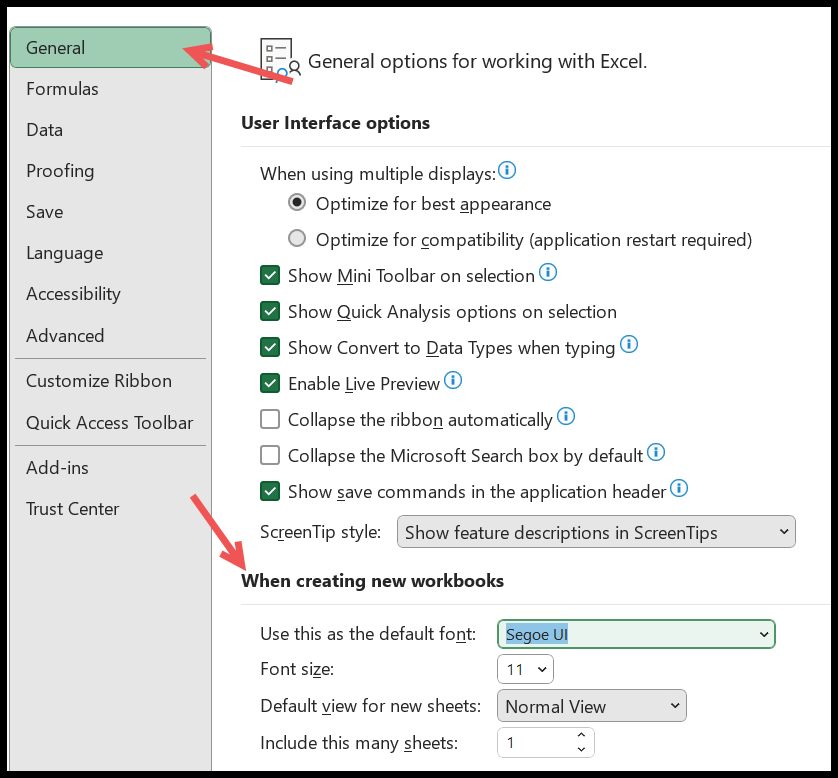
- From there, select the font from “Use this as the default font”. By default, it’s set to “Body Font”, which means the font comes from the workbook theme.

- Next, change the size from “Font size”.
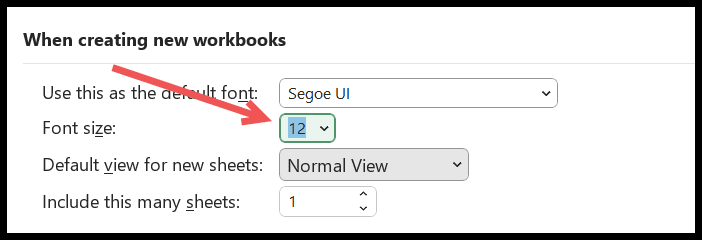
- In the end, click OK to save the settings, and Excel will tell you to close and restart your Excel application.

And once you restart the Excel application, you will get the new default font with each new workbook you create.

This change in settings will not make any changes to existing files which are already saved.
Use Font Themes for Multiple Default Fonts
If you want to have multiple default fonts, you can create a font theme that helps you change the font of the workbook whenever you want.
- First, go to Page Layout ⇢ Themes ⇢ Fonts.
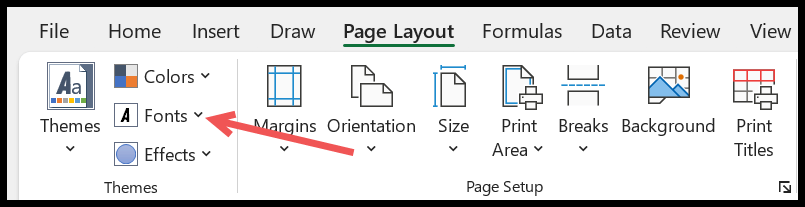
- Now, click on the Fonts drop-down and click on “Customize Fonts”.

- In the “Create New Theme Fonts” dialog box, specify the body font that you want to use.

- In the end, enter a name for the theme and click on the “Save” button to save the font theme.
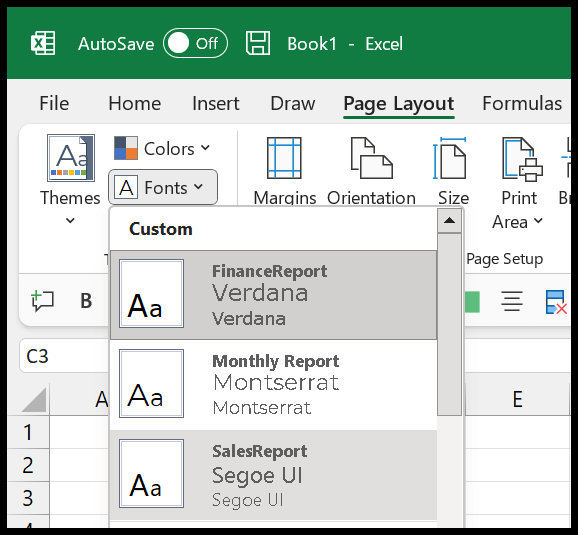
You can create multiple font themes and change the font of the current workbook with a single click. A theme font changes all the cells that use the theme font, like the Normal style, but not the cells where you have picked a font yourself.
Create a Template with the Default Font
If you need a different default font only for some specific workbooks, you can change the font and save the workbook as a template. And whenever you need that specific font as the default, you can create a new workbook using that template.
- First, change the font of the workbook by using the steps we have discussed above (a font theme), or by changing the Normal style (Home ⇢ Cell Styles ⇢ right-click Normal ⇢ Modify ⇢ Format).
- Next, go to the “File” tab and use the Save As option.

- After that, from “Save as type”, select “Excel Template”.

- Now, when you select “Excel Template”, it will take you to the location where you can save Custom Office Templates.

- In the end, give a name to the template and click on the Save button.

Now, whenever you need to use it, go to File ⇢ New ⇢ Personal and pick your template. Excel opens a new copy of it, so you only need to save it as a new file. You don’t need to make changes to the font style and size at all.
Make the Font Default for New Sheets Too
The Excel Options setting changes the font for new workbooks, but if you want the same font when you insert a new sheet in any workbook, save templates named Book.xltx (for new workbooks) and Sheet.xltx (for new sheets) in the XLSTART folder. Excel uses these files every time you create a new workbook or insert a sheet.
Frequently Asked Questions
Why does Excel use Aptos Narrow instead of Calibri?
Microsoft changed the default font of Microsoft 365 from Calibri to Aptos, and Excel uses Aptos Narrow for cells. If you prefer Calibri, select it in File ⇢ Options ⇢ General ⇢ Use this as the default font, and restart Excel.
Why didn’t my old files change to the new default font?
The default font only applies to new workbooks. Existing files keep their own fonts, so change them with a font theme or by modifying the Normal style.
Can I change the default font color in Excel?
There’s no option for the default font color in Excel Options. Modify the Normal cell style (Home ⇢ Cell Styles ⇢ right-click Normal ⇢ Modify ⇢ Format ⇢ Font) and save it in a template.