

While working in Excel, there might be a situation where you need to delete a row or multiple rows from your worksheet. In this tutorial, we will go through the various methods for this.
Let’s understand each method one by one.
Steps to Delete a Single Row

- First, click the row header (the row number) of the row you want to delete to select the entire row.
- Then, right-click on the selected row header.
- From here, you need to use the Delete option.
- Click the Delete option to delete the row from the worksheet. The rows below it move up.
Steps to Delete Multiple Continuous Rows
If you have to delete multiple rows at once in your worksheet, follow the steps below:
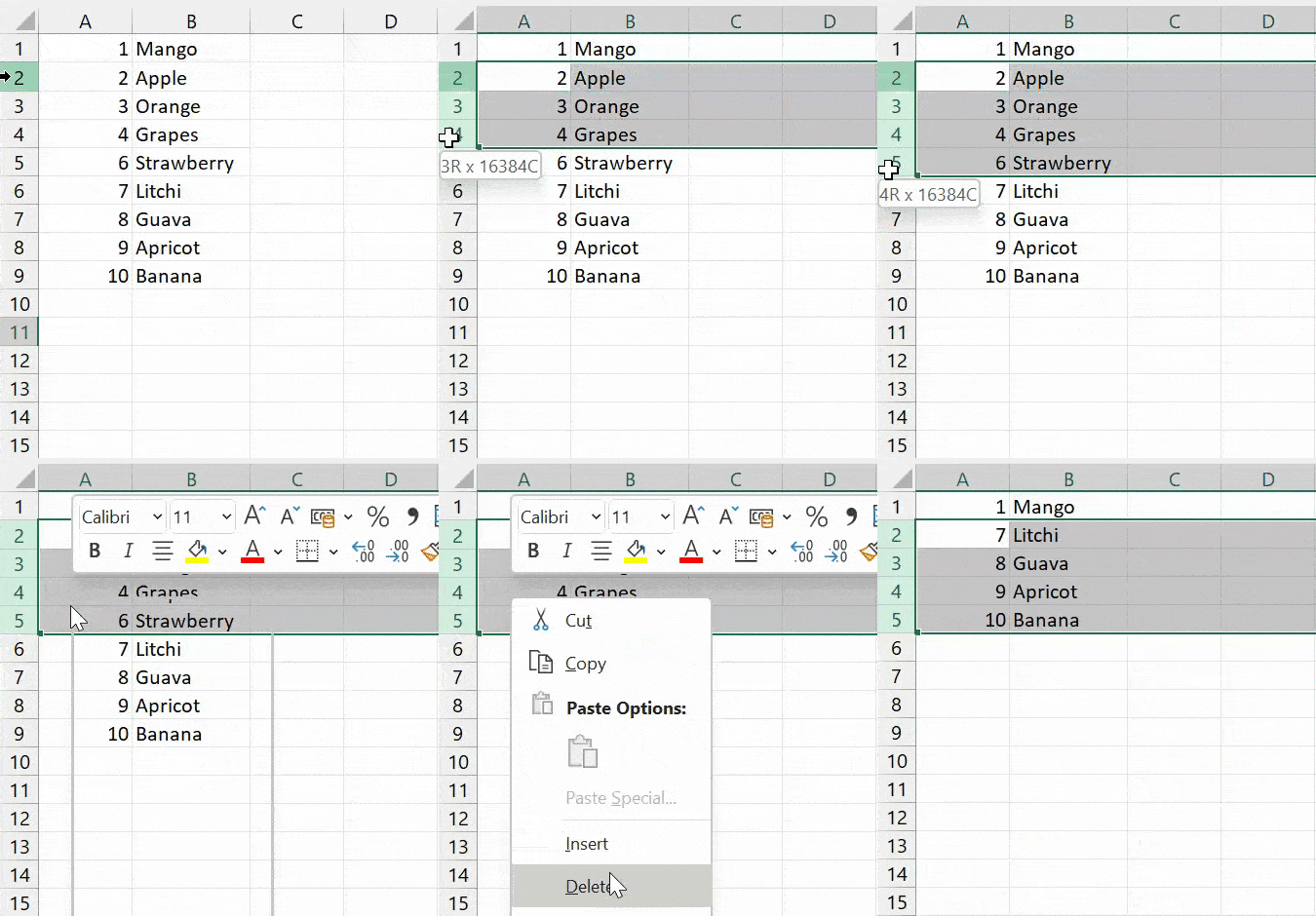
- First, select all the rows you want to remove by dragging over their row headers.
- Next, right-click on one of the targeted rows.
- And now, click on the Delete option from the menu.
- Once you click on the Delete option, you will see all the selected rows have been deleted from the worksheet.
Delete Multiple Non-Continuous Rows
Deleting multiple non-adjacent rows from the sheet is just as easy. Here are the steps for this:
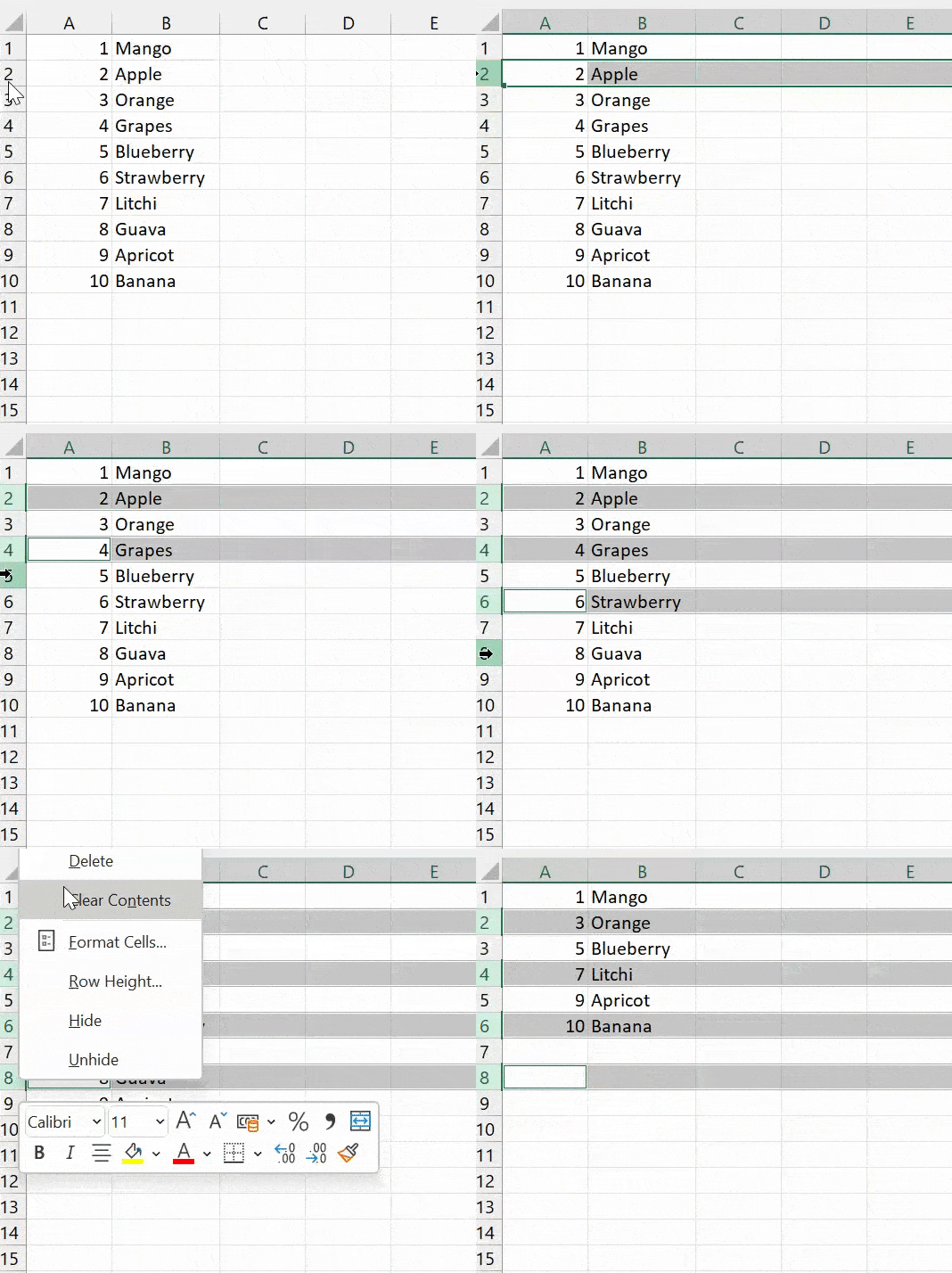
- Initially, press and hold the Ctrl key and click the row headers of the non-adjacent rows one by one.
- After that, move the cursor to the header of one of those rows.
- Now, right-click on it and click the Delete option.
- The moment you click Delete, it will delete all the selected non-continuous rows.
Delete Rows by using a Ribbon Command
Another way to delete rows from the spreadsheet is the Delete command on the ribbon. Here are the steps for this.
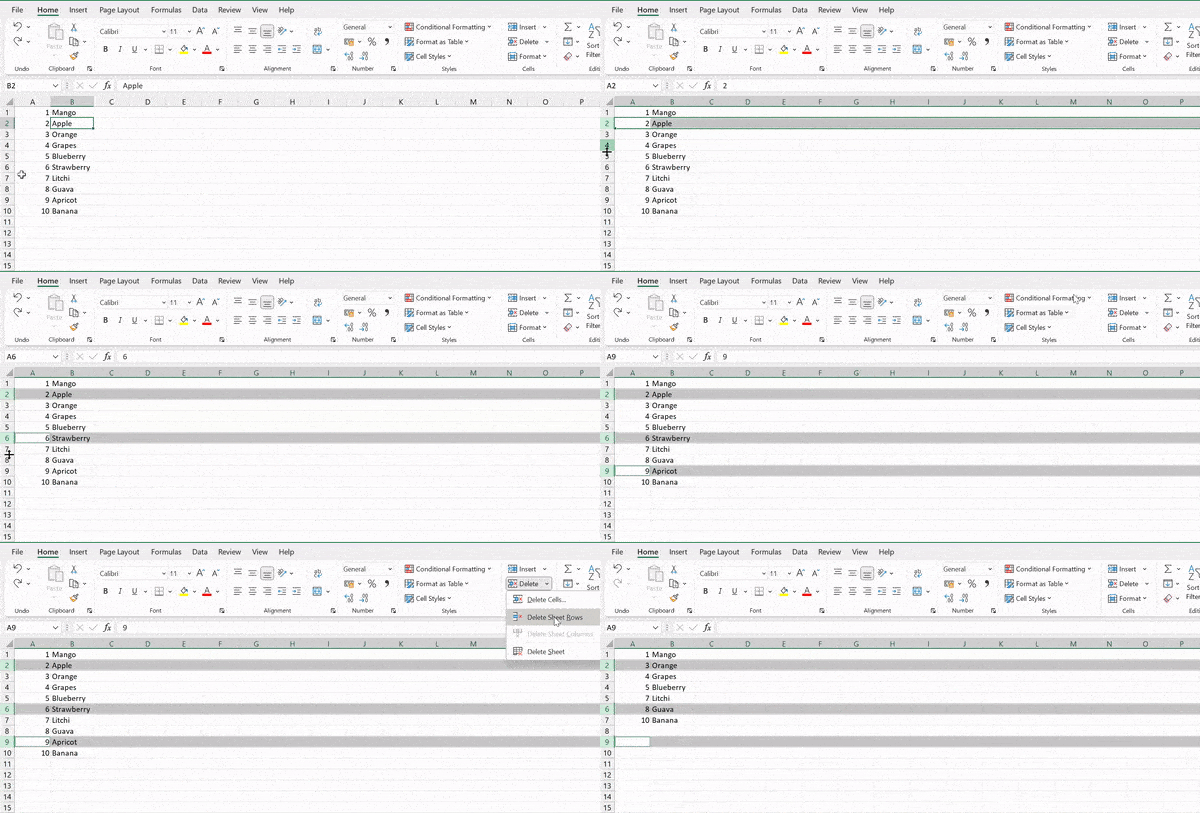
- To delete the rows in Excel, first select the single or multiple rows (or any cells in those rows) that you would like to delete.
- Now, on the ribbon’s Home tab, go to the Cells group and click the arrow on the Delete button.
- After that, select the Delete Sheet Rows option from the drop-down list.
- Once you click on it, you will see all the selected rows are removed from the sheet.
You can also use the shortcut Ctrl+ (-) from the keyboard to quickly delete the rows. If whole rows are selected, it deletes them right away; if only cells are selected, it opens the Delete dialog box, where you choose Entire row. To select the whole row of the active cell first, press Shift + Spacebar.
Delete Rows Based on a Condition
If you want to delete all the rows with a specific value, like every row where the status is “Cancelled”, use a filter:
- First of all, select the data and turn on the filter with Ctrl + Shift + L.
- After that, filter the column to show only the rows you want to delete.
- Next, select the visible rows from their row headers, right-click and choose Delete Row. Excel deletes only the visible rows.
- In the end, clear the filter to see the rest of your data.
Delete Blank Rows
To remove empty rows from a list, select the column that should never be empty, press F5 ➜ Special ➜ Blanks ➜ OK, and then go to Home ➜ Delete ➜ Delete Sheet Rows. Be careful: this deletes every row that has a blank cell in that column, even if other cells in the row have data, so check the selection before you delete.
Delete Rows vs Clear Contents
Pressing the Delete key on a selected row doesn’t delete the row. It only clears the values, and the empty row stays in place. To remove the row itself and move the rows below it up, use one of the Delete methods above. In an Excel table, right-click a cell and choose Delete ➜ Table Rows to delete the row only from the table.
Wrap Up
So, these are the ways, including a shortcut, to get rid of the rows you don’t want in your worksheet. They also help you save time and do things in a better way.
Now, tell me a thing. “Which method do you like the most?” Please write to me in the comment section below; I would love to hear from you.
Frequently Asked Questions
Why is Delete Sheet Rows grayed out?
Most likely, the sheet is protected without the Delete rows permission, or the workbook is shared or read-only. Unprotect the sheet from Review ➜ Unprotect Sheet and try again.
Can I undo deleting rows?
Yes, press Ctrl + Z right after you delete them. But if the rows were deleted by a macro, Undo doesn’t work, so save a copy before you run it.
Do formulas break when I delete rows?
Formulas that refer to a range adjust on their own, like SUM(A1:A10) becoming SUM(A1:A9). But a formula that refers directly to a cell in the deleted row shows the #REF! error.