

To find the latest date in a list, use =MAX(A2:A20). Dates are stored as numbers, so MAX works on them exactly as it does on any other number. The one thing that trips people up is the result appearing as a serial number like 45240 — that’s the cell format, not the formula, so press Ctrl+1 and set it to Date.
For the earliest date, use =MIN(A2:A20), and for the second-latest, =LARGE(A2:A20,2). To find the latest date meeting a condition, use MAXIFS: =MAXIFS(B2:B20,A2:A20,"North") gives the most recent date for the North region, and you can bound it by a date range with =MAXIFS(B2:B20,B2:B20,">="&DATE(2026,2,1),B2:B20,"<="&DATE(2026,3,31)).
Build the criteria dates with DATE rather than typing them as text, since a text date depends on regional settings. MAXIFS needs Excel 2019 or later; on older versions use =MAX(IF(A2:A20="North",B2:B20)) entered with Ctrl+Shift+Enter.
Both MAX and MAXIFS ignore dates stored as text, so a left-aligned date won’t be considered at all.
In Excel, you can use a simple formula if you have a list of dates and want to get the date that is the max out of all those. For this, all you need to do is use the MAX function, and if you want to get the max date using a condition, then you need to use MAXIFS.
This tutorial will help you understand both functions to get the max date.

Formula to Get the Max Date
- First, in a cell, enter the MAX function.
- Now, enter the opening parenthesis to start the function.
- Next, refer to the range where you have the list of dates.
- In the end, enter the closing parenthesis and hit Enter to get the result.
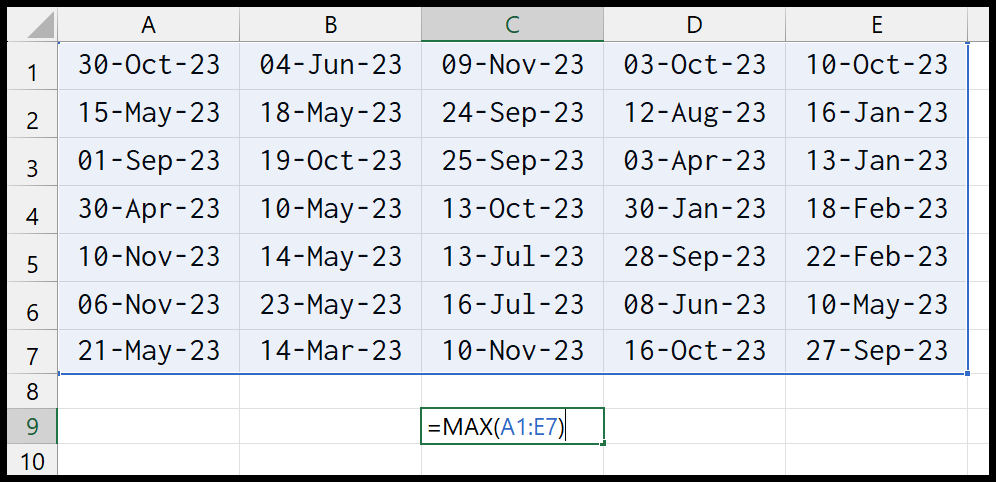
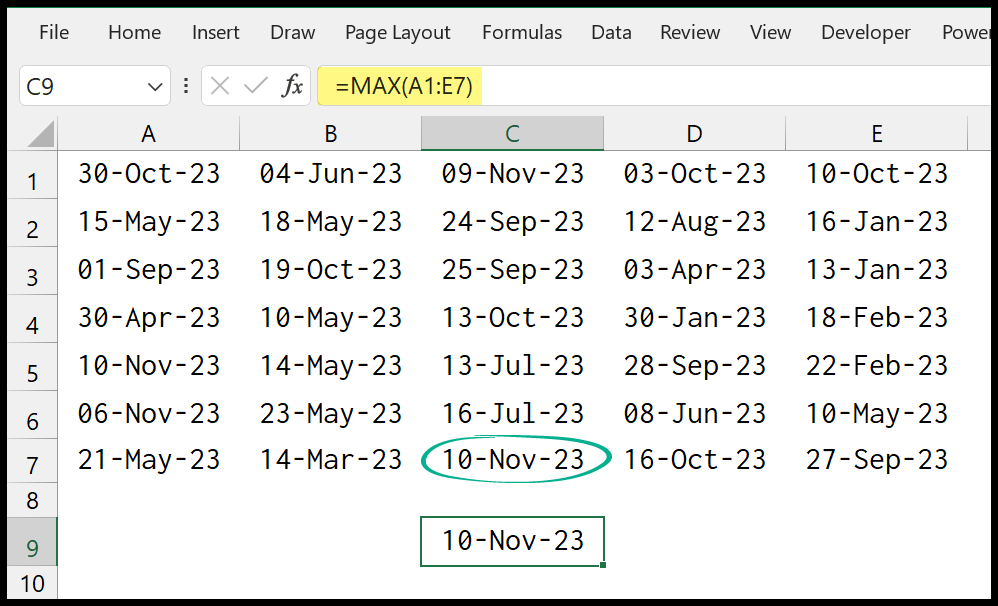
Once you hit Enter, it returns the max date from the data. And in our example, 10-Nov-2023 is the max date.
=MAX(A1:E7)
MAX returns the date as a number, so if you see a number like 45240, apply a date format to the cell. Dates stored as text are ignored, and if the range has no dates, MAX returns 0, which shows as 00-Jan-1900 with a date format.
Get the Max Date with a Condition
Now if you want to get the max date from the same data but by using a condition, you need to use the MAXIFS function.
=MAXIFS(A1:E7,A1:E7,">"&DATE(2023,2,1),A1:E7,"<"&DATE(2023,3,31))
In the above formula, we have specified a condition to get the maximum date between 01-Feb-2023 and 31-Mar-2023. And it returns 14-Mar-23 in the result.
To understand this, you must know the MAXIFS function and its arguments.
- max_range
- criteria_range1
- criteria1
- criteria_range2
- criteria2
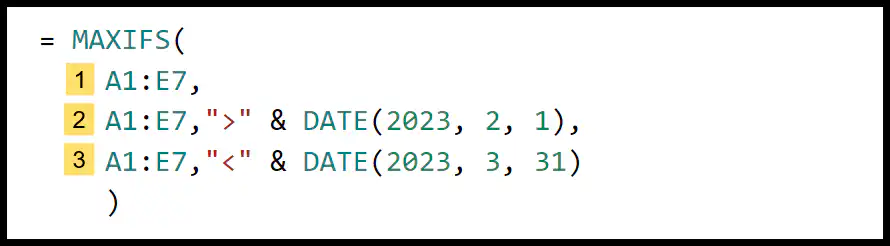
- First, specify the max_range from where you want to get the max date.
- After that, in the criteria_range1, you need to specify the same range again where you have the dates. In criteria1, you need to specify the lowest date of the date range along with the greater than operator (>).
- Next, in the criteria_range2, you need to specify the same date range again. In criteria2, you need to specify the highest date and the less than operator (<).
- In the end, close the function and hit Enter to get the result.
Note: We have used the DATE function to specify the date in the criteria.
With “>” and “<”, the dates 01-Feb-2023 and 31-Mar-2023 themselves are left out. To include them, use “>=” and “<=”:
=MAXIFS(A1:E7,A1:E7,">="&DATE(2023,2,1),A1:E7,"<="&DATE(2023,3,31))
Max Date for a Specific Item
MAXIFS can also check another column. For example, to get the latest date for “North” when the dates are in A2:A100 and the regions in B2:B100, use:
=MAXIFS(A2:A100,B2:B100,"North")
Max Date with a Condition in Older Excel
MAXIFS is available in Excel 2019 and later and in Microsoft 365. In Excel 2016 and older, you can use AGGREGATE, which ignores the errors the division creates for dates outside the range:
=AGGREGATE(14,6,A1:E7/((A1:E7>=DATE(2023,2,1))*(A1:E7<=DATE(2023,3,31))),1)
Frequently Asked Questions
Why does MAX return 0 or a date in 1900?
The range has no real dates. The dates are probably stored as text, which MAX ignores. Convert them with DATEVALUE or Text to Columns, and the formula will work.
How do I get the earliest date?
Use MIN instead of MAX, or MINIFS instead of MAXIFS for the earliest date with a condition.
Can I use cells for the start and end dates?
Yes. Join the operator with the cell, like “>=”&G1 and “<=”&H1, so you can change the dates without editing the formula.
Written by
Puneet Gogia
Microsoft MVP — Excel · Founder, Excel Champs
Twelve years of teaching Excel, and a decade before that using it as a data analyst. Every tutorial here is written from a file I actually built.