

To calculate the nth root of a number, raise it to the power of 1/n: =A1^(1/3) for the cube root, =A1^(1/5) for the fifth root, and so on. =POWER(A1,1/3) does exactly the same thing if you prefer a named function. The parentheses around 1/3 are essential — without them, =A1^1/3 divides the result by 3 instead.
Negative numbers need care: an odd root of a negative number is a real number (the cube root of -125 is -5), and you get it with =SIGN(A1)*ABS(A1)^(1/3). An even root of a negative number has no real answer at all, so =A1^(1/4) correctly returns #NUM! and no formula will fix that.
The most common practical use of an nth root is compound growth: =(End/Start)^(1/Years)-1 gives the CAGR, so a value growing from 100 to 250 over 5 years works out at about 20% a year.
The easy and quick way to get the nth root of a number is to use the caret operator. Otherwise, you can use Excel’s POWER function. In this tutorial, you will learn to use both methods.

Let’s calculate the 10th root for the number 1953125.

Use CARET (^) Operator to Get the Nth Root of a Number
You can use the below steps:
- First, enter the equal operator in a cell and refer to the number for which you want to get the nth root.
- After that, enter the caret operator.
- Next, enter the starting parentheses.
- Now, enter 1/10 as you need to calculate the 10th root.
- In the end, enter the closing parentheses and hit enter to get the result.

=A1^(1/10)Let’s say you want to calculate any other root for a number; you need to change the nth number from the formula:
=original_number^(1/nth_root)Ensure that (1/nth_root) is always in the brackets to have the right order of operations in the calculation.
[thrive_leads id=’112075′]Calculate Nth Root with POWER Function
You can use the below steps:
- First, enter the POWER function in the cell and the starting parentheses.
- Now, in the first argument, refer to the original number.
- Next, in the second argument, enter 1/10.
- In the end, enter the closing parentheses and hit enter to get the result.

POWER(A1,1/10)In this method, you must divide 1 with the nth root to get the result. The only difference is that you don’t need to use the caret operator.
For both methods, you need to change the nth root. Change it in the formula if you want to get the 4th, 5th, or any other root.
Nth Root for a Negative Number
If you have a negative number and you want to get the nth root of that number, you need to use the ABS function just like the following examples:
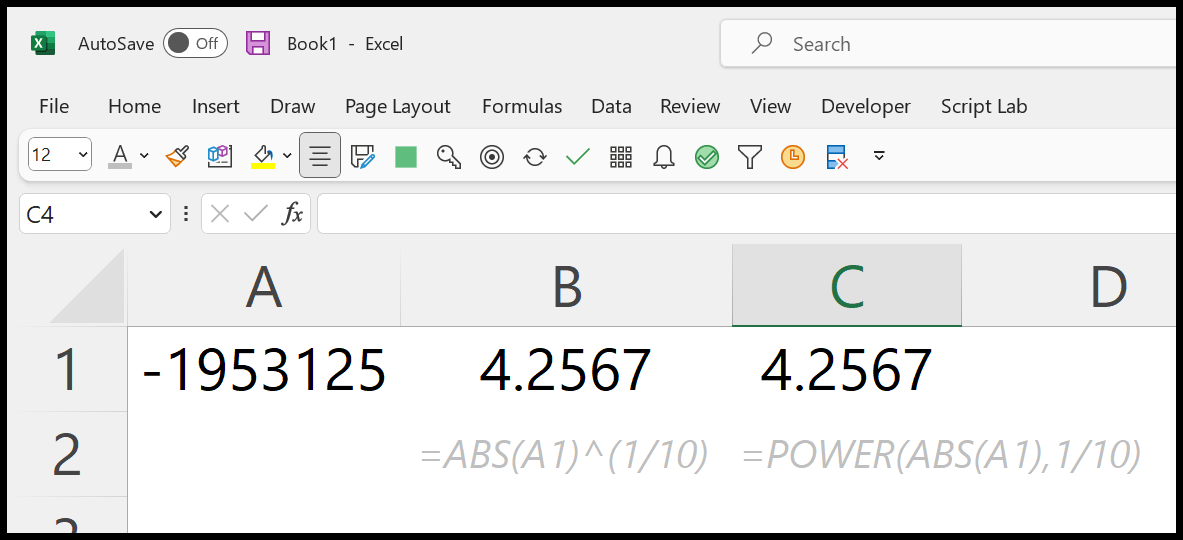
=ABS(A1)^(1/10)
=POWER(ABS(A1),1/10)
Written by
Puneet Gogia
Microsoft MVP — Excel · Founder, Excel Champs
Twelve years of teaching Excel, and a decade before that using it as a data analyst. Every tutorial here is written from a file I actually built.