

The simplest way to find the smallest number in a range is =MIN(A2:A12). Use =SMALL(A2:A12,1) when you want the flexibility to change the position — =SMALL(A2:A12,2) gives the second smallest, =SMALL(A2:A12,3) the third, which MIN can’t do.
Both ignore blank cells and text, and both ignore numbers stored as text, so a value that’s left-aligned in the cell won’t be considered. To find the smallest value that meets a condition, use =MINIFS(B2:B12,A2:A12,"North") in Excel 2019 or later.
To exclude zeros — common when blank rows have been filled with 0 — use =MINIFS(A2:A12,A2:A12,"<>0"), or =SMALL(A2:A12,COUNTIF(A2:A12,0)+1) on older versions. One error to know: SMALL returns #NUM! if you ask for a position beyond the number of values in the range, or if the range has no numbers at all.
To find the smallest number in Excel, you can use Excel’s SMALL Function. This function allows you to refer to a range where you have numbers, and specify the n value (for example, if you want to get the smallest number, enter 1).
This tutorial will teach you to write a quick formula to get the smallest number.
Formula to Find Lowest Number in Excel
You can use the following steps:
- First, enter the SMALL function in a cell.
- After that, refer to the range where you have numbers.
- Next, enter the n values to find the nth number.
- In the end, hit enter to get the result.
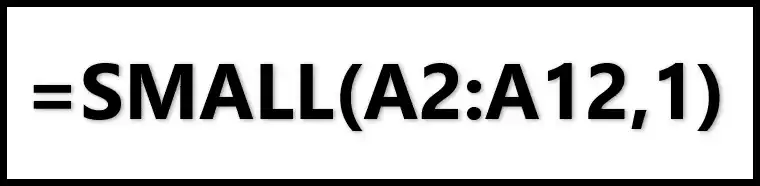
=SMALL(A2:A12,1)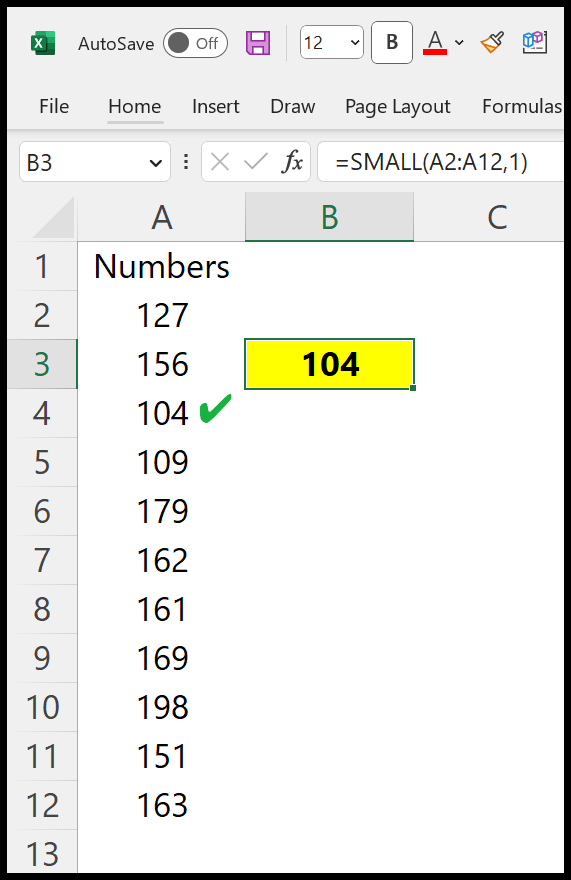
In your list 104 is the smallest number and that’s exactly what you have got in the result. And if you somehow want to get the 3rd smallest number you can use the 3 in the k argument in the function.
Written by
Puneet Gogia
Microsoft MVP — Excel · Founder, Excel Champs
Twelve years of teaching Excel, and a decade before that using it as a data analyst. Every tutorial here is written from a file I actually built.