

Press Ctrl + W to close the active workbook and leave Excel open. If there are unsaved changes, Excel asks you to Save or Don’t Save first. Ctrl + F4 does the same.
Press Alt + F4 to close the active Excel window. Since Excel 2013 each workbook opens in its own window, so with several workbooks open this closes only the current one, and with one workbook open it quits Excel.
To close every open workbook and quit Excel in one go, press Alt, F, X one key after another. It runs the Exit command, which is no longer listed on the File screen but still answers to this key tip in Excel 2013 to 2019; test it in your Microsoft 365 build. Excel prompts you for each workbook with unsaved changes.
A no-shortcut alternative that closes them all: right-click the Excel icon on the Windows taskbar and choose Close all windows. You get the same save prompts.
The difference that catches people out: Ctrl + W on the last open workbook leaves an empty Excel window behind, while Alt + F4 on the last workbook closes Excel completely.
Latest Video Tutorial – 10 Excel Keyboard Shortcuts (Probably YOU are NOT Using)
Excel has shortcuts to close only the current workbook or to close the entire Excel application, which closes all open workbooks in one go.
So, you can choose whether you want to close only the current workbook or all open workbooks with a keyboard shortcut.
Keyboard Shortcuts to Close the Workbook(s) in Excel
The keyboard shortcuts to close the current workbook or all open workbooks are mentioned below:
To Close the Workbook:
Ctrl + W or Alt + F4
To Close the Excel Application (Excel 2010 and older):
Alt → F → X
Steps to Close the Workbook(s) Using Keyboard Shortcut
- First, go to the workbook that you want to close.
- After that, simply press the “Ctrl + W” keys or the “Alt + F4” keys, and your current workbook will be closed.
- Or, in Excel 2010 and older, go to any open workbook and press the “Alt → F → X” keys in sequence (File ➜ Exit), and all the open workbooks will be closed in one go.
From Excel 2013 onwards (including Microsoft 365), the File tab has no Exit command, and each workbook opens in its own window. So, Alt + F4 closes only the current workbook window, and Excel closes when you close the last one. To close all workbooks in one go, you can add the Exit command to the Quick Access Toolbar (File ➜ Options ➜ Quick Access Toolbar ➜ All Commands), or run this one-line macro:
Sub close_excel()
    Application.Quit  ' Asks to save each changed workbook
End Sub
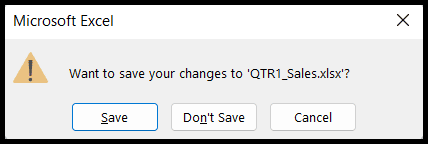
In case you make any change in Excel, like entering a value or updating a cell, and don’t save the workbook before closing, Excel asks whether you want to save the changes before it closes the workbook.
Frequently Asked Questions
What is the difference between Ctrl + W and Alt + F4?
Ctrl + W (or Ctrl + F4) closes the workbook. Alt + F4 closes the window; in Excel 2013 and later, each workbook has its own window, so the result is the same unless it’s the last workbook, in which case Excel closes too.
What is the shortcut to close a workbook on a Mac?
Press Cmd + W to close the workbook, and Cmd + Q to quit Excel and close all the open workbooks.
Can I close a workbook without the save prompt?
Press N (Don’t Save) when the prompt appears. In VBA, use ActiveWorkbook.Close SaveChanges:=False to close it without saving.