
To start a new line inside a cell, double-click into it and press Alt + Enter at the point where you want the break (Ctrl + Option + Enter on Mac). Excel turns on Wrap Text automatically when you do it this way.
To add breaks across a whole column with a formula, join the values with CHAR(10): =A2&CHAR(10)&B2, or =TEXTJOIN(CHAR(10),TRUE,A2:C2) for three or more values. With formulas, Excel does not turn on Wrap Text for you — that’s the reason a line break usually looks like it hasn’t worked, so apply Wrap Text to the column afterwards.
To add breaks to data you already have, press Ctrl + H, put the comma or space in “Find what”, click into “Replace with” and press Ctrl + J (nothing visible appears, which is normal), then Replace All. The same trick removes them: Ctrl + J in “Find what”, leave “Replace with” empty. Or use =SUBSTITUTE(A1,CHAR(10)," ") to swap each break for a space.
Method |
Use it when… |
What you do |
Wrap text |
|---|---|---|---|
Alt + EnterShortcut |
You’re typing in one cell and want a quick break |
Press Alt + Enter (Mac: Ctrl + Option + Enter) |
Auto |
& + CHAR(10)Formula |
You’re joining values down a whole column |
=A2&CHAR(10)&B2 |
Apply manually |
TEXTJOIN + CHAR(10)Formula |
You’re combining 3 or more values into one cell |
=TEXTJOIN(CHAR(10),TRUE,A2:C2) |
Apply manually |
Named RangeTrick |
You reuse the line break across many formulas |
Name NL = CHAR(10), then =A2&NL&B2 |
Apply manually |
Find & ReplaceTool |
You’re adding or removing breaks in existing data |
Open Find & Replace, press Ctrl + J in the box |
Apply manually |
Excel gives you more than one way to start a new line within a cell, and the right method depends on what you’re trying to do. If you just want a quick line break while typing, the keyboard shortcut Alt + Enter is the fastest way.
But when you need to add a line break (carriage return) across many cells at once, a formula with the CHAR function does the job far better. And if you find yourself doing this all the time, you can even save the line break as a named range and reuse it.
In this tutorial, I’ll walk you through all five methods to insert a new line in a cell. I’ll also cover one thing most people miss: without wrap text enabled, your line break stays hidden, so I’ll show you exactly where it fits in each method.

Start a New Line in Excel in a Cell (Manually)
In the following example, I want to add my name to cell A1, but I want to add my last name to a new line inside the cell only. So let’s use the following steps for this:
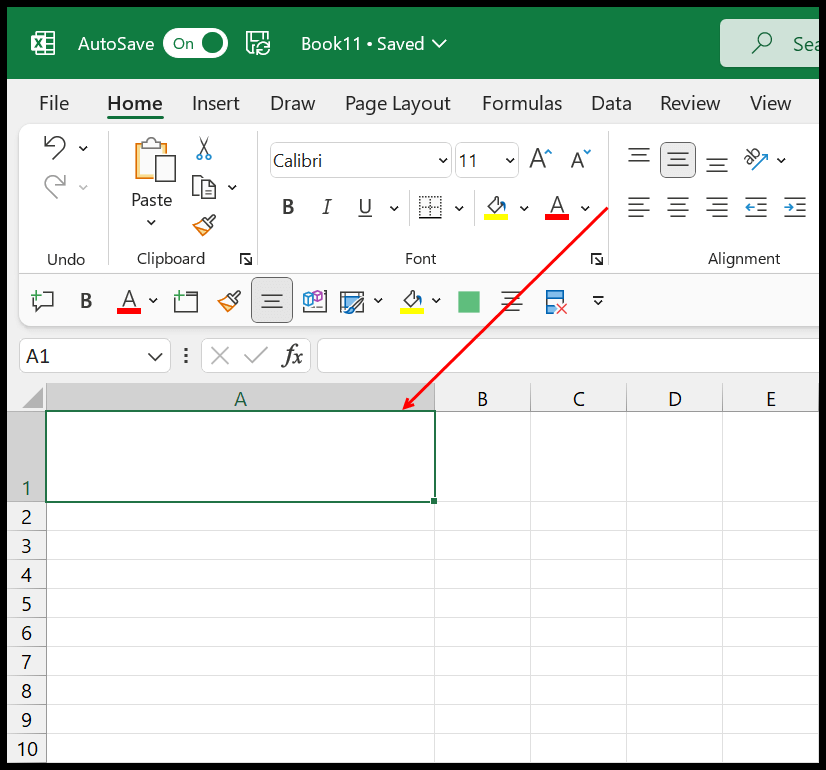
- The first thing that you need to do is to edit the cell and enter the first value by normally typing it.
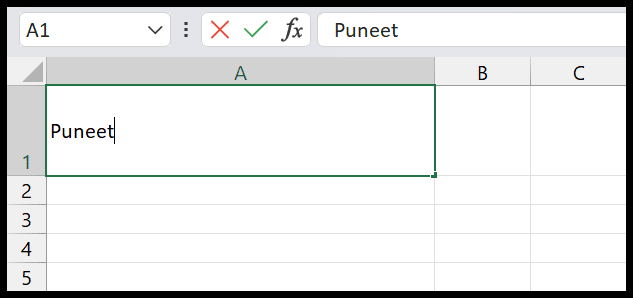
- After that, you need to press and hold the ALT key from your keyboard.
- Next, you need to press the enter key while pressing and holding the ALT key. This will move your cursor to the new line.
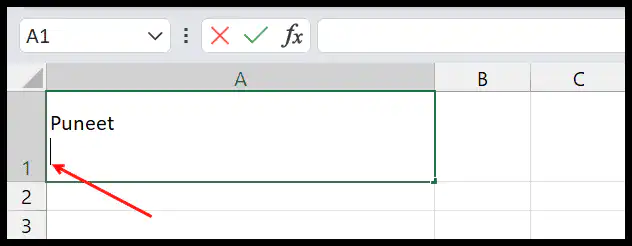
- Now, you can enter the last name in the second line, just by typing it.
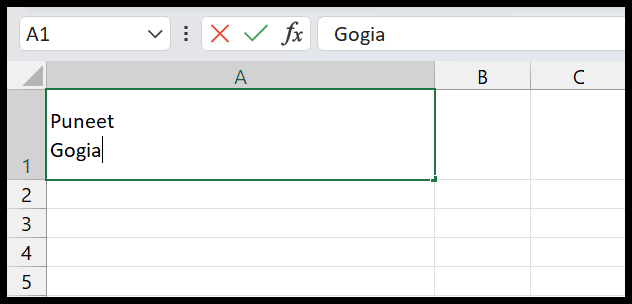
- In the end, hit enter to come out of the edit cell mode.
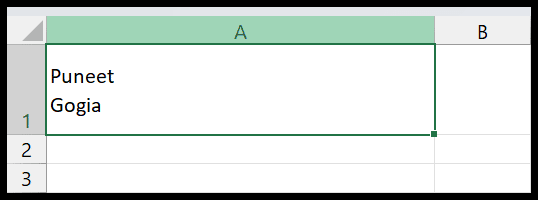
So here you have a cell with a value on the new line (second line) within the cell.
But there is one thing you need to know: when you insert a new line in a cell using the keyboard shortcut, Excel automatically activates wrap text for that cell.
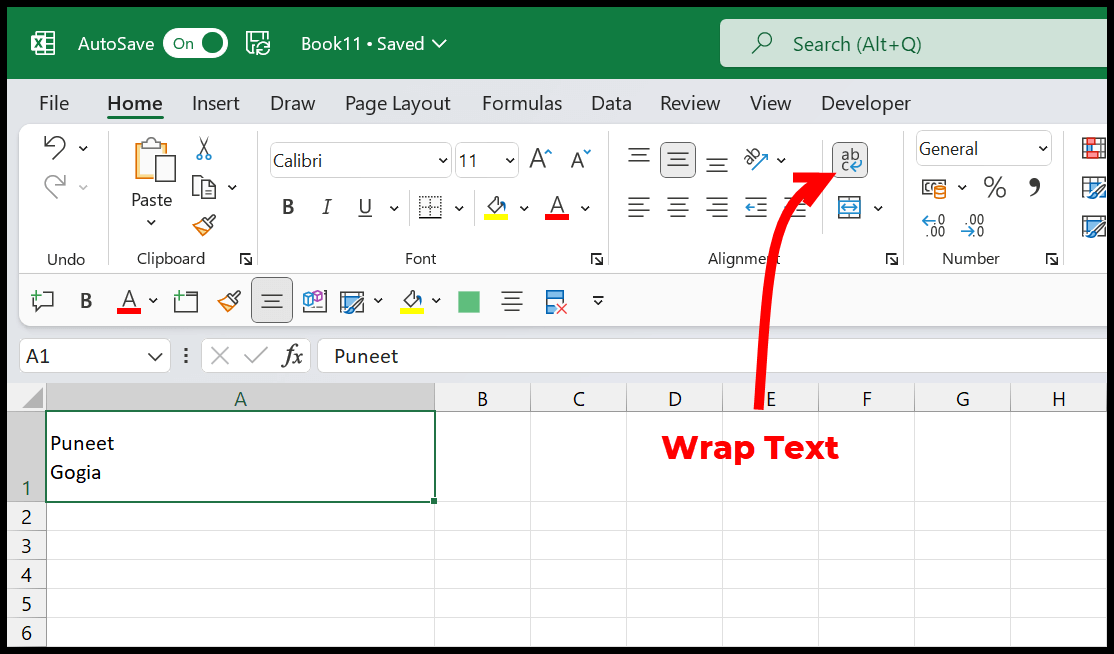
If you remove this wrap text formatting from the cell, you will also remove the new line you added while entering the values.
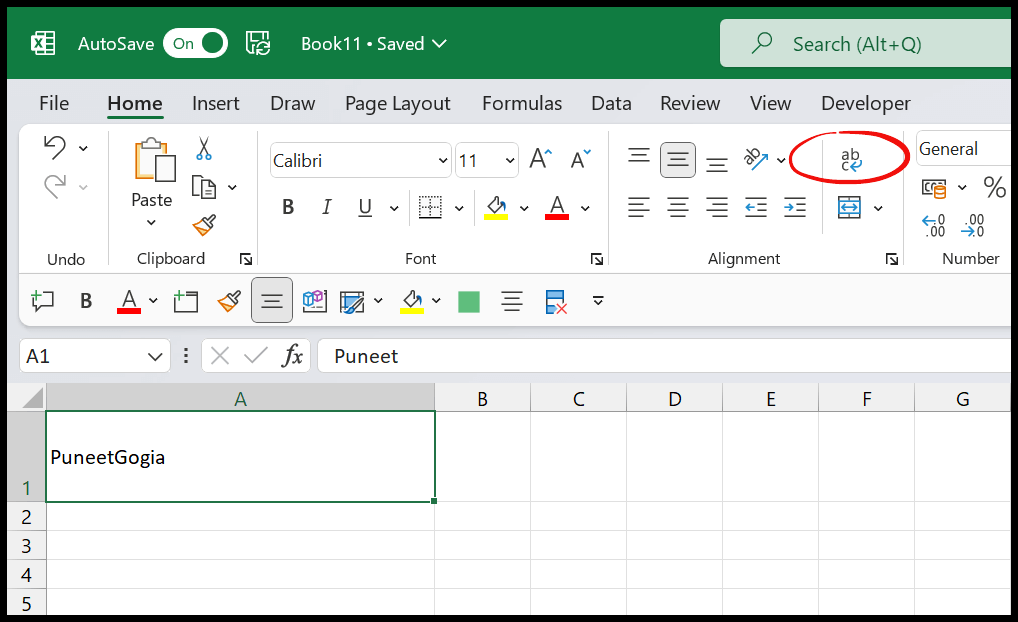
Formula to Add a New Line in a Cell in Excel
If you need to insert a new line in multiple cells at once, the best way is to use a formula. In the following example, you have first and last names in columns A and B.
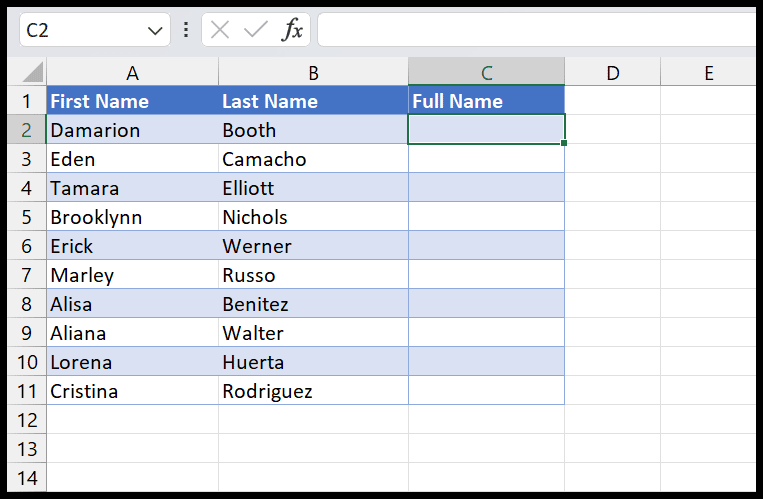
Now, you need to CONCATENATE both to get the full name in column C. Here, you also need to use the CHAR function to enter a new line within the cell.
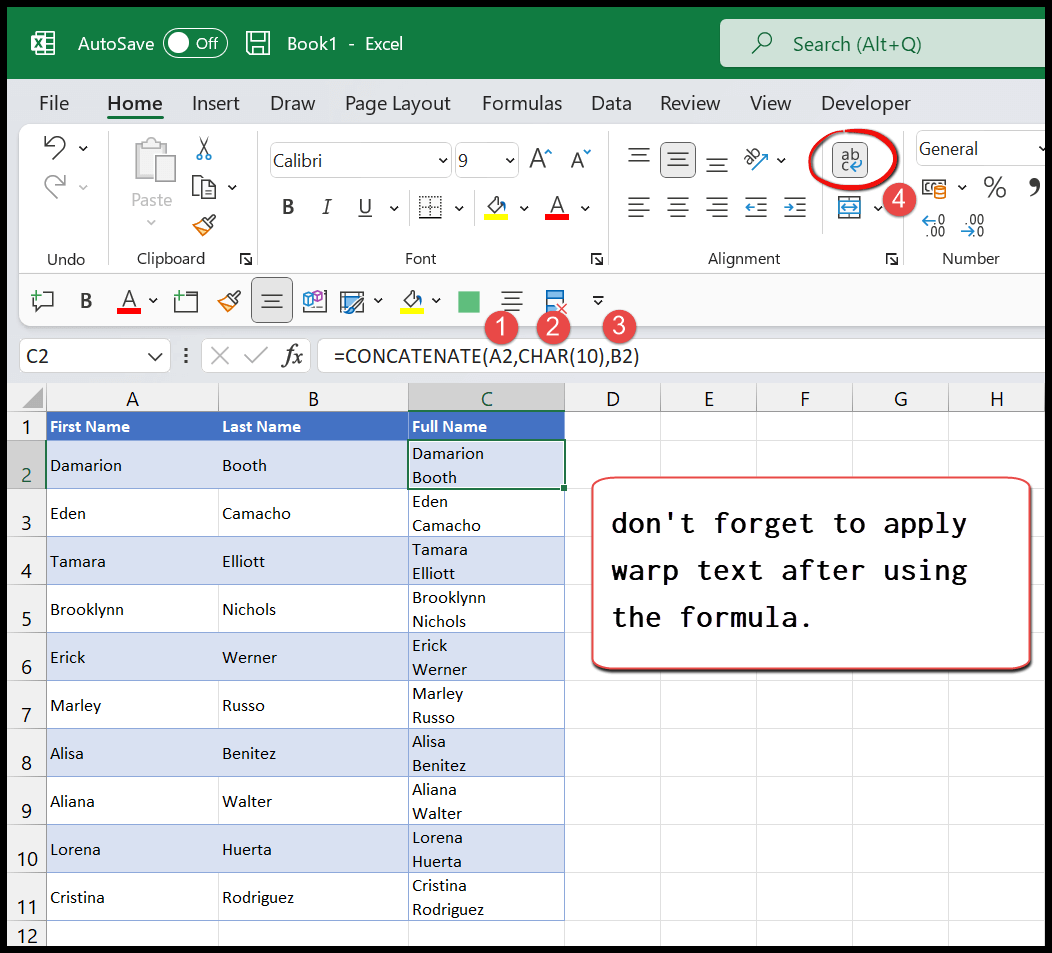
- The first thing is to enter the CONCATENATE function in cell C2.
- After that, in the first argument, refer to cell A2 where you have the first name.
- Next, in the second argument, enter the CHAR function with 10 as the argument.
- From here, in the third argument, refer to cell B2, where you have the last name.
- Now, hit the Enter key and apply this formula to all the names that you have in the column.
- In the end, to get the line break, you need to apply wrap text to the entire column C.
In the same way, you can use TEXTJOIN as well, which also helps you combine two values from the cell, and then, using the CHAR function, you can add a new line (line break) within the cell.
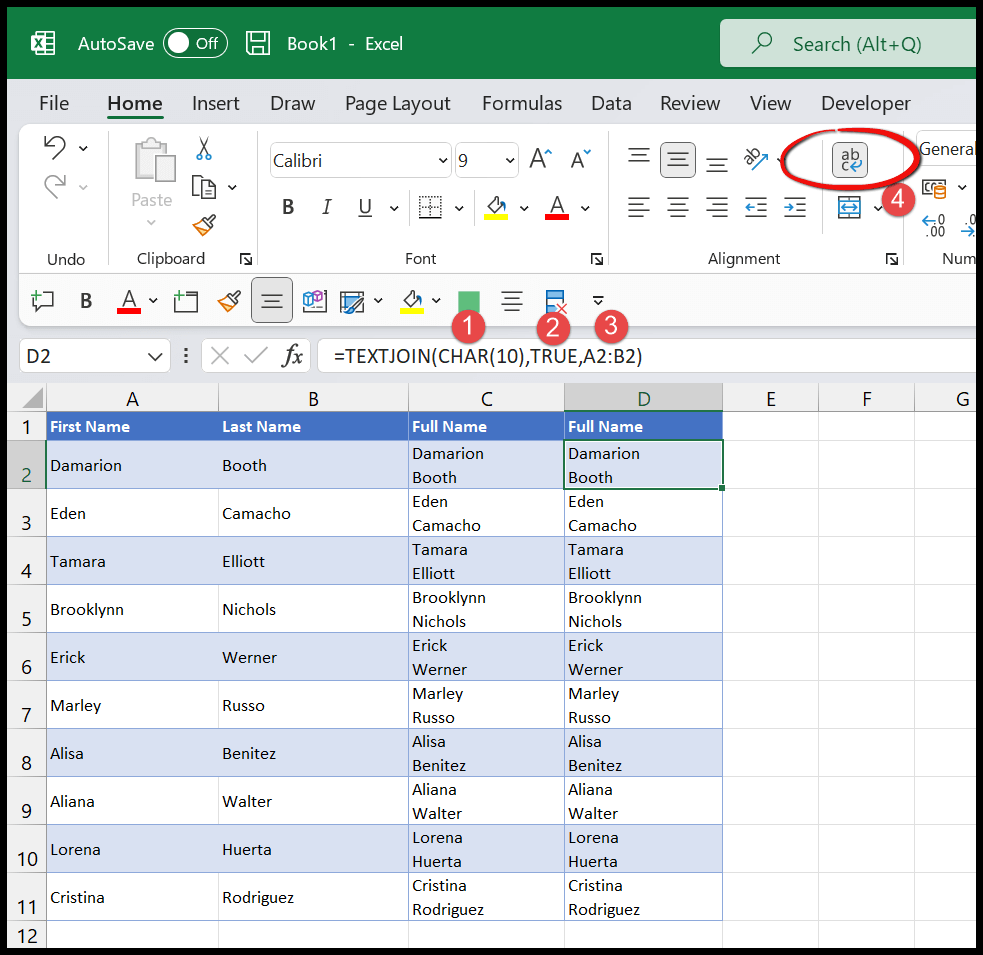
Once you create a formula using TEXTJOIN and CHAR, you also need to apply the wrap text formatting to the cell, so that it shows both values in two different lines using a line break.
Remove a Line Break (New Line) from a Cell in Excel
Sometimes you need to do the exact opposite, you’ve got line breaks sitting inside your cells and you want to clear them out. There are two quick formulas for this, depending on what you want the result to look like.
The first one is the CLEAN function. CLEAN removes all the non-printable characters from a cell, and a line break happens to be one of them. So you just refer to the cell:
=CLEAN(A1)
This strips the line break out and pulls everything onto a single line. But there’s one thing to keep in mind: CLEAN removes the break completely, so the two values end up joined with no space between them.
If you’d rather replace the line break with a space (or a comma, or anything else), use SUBSTITUTE instead:
=SUBSTITUTE(A1,CHAR(10)," ")
Here, you’re telling Excel to find every CHAR(10) in cell A1 and swap it for a space. Want a comma instead? Just change the last argument to ", ".
Ctrl + J in the “Find what” box, leave “Replace with” empty, and hit Replace All. That’s all.
Using Find and Replace to Add a New Line in a Cell
There’s one more method I really like when I already have data in my cells and I want to add a line break in bulk: Find and Replace.
Let’s say you have first and last names separated by a comma (or a space) in a column, and you want each part on a new line. Instead of editing every single cell, you can swap that comma for a line break in one go.
Here’s how to do it:
- 1First, select the range of cells where you want to add the line break.
- 2After that, press
Ctrl + Hto open the Find and Replace dialog box. - 3In the “Find what” box, enter the character you want to replace — for example, a comma (,) or a space.
- 4Next, click inside the “Replace with” box and press
Ctrl + J. You won’t see anything appear, but this inserts a line break (theCHAR(10)character) into the box. - 5In the end, click “Replace All”, and Excel adds a new line everywhere it finds that character.
Ctrl + J, nothing visibly shows up in the “Replace with” box — that’s completely normal. And just like the other methods, if your line break still doesn’t appear, turn on Wrap Text for the cells.
And the best part? This works the other way around too. To remove line breaks, just put your cursor in the “Find what” box, press Ctrl + J, leave “Replace with” empty (or add a space), and hit Replace All. That’s all.
Named Range Trick to Insert a New Line in a Cell
You can also create a named range in Excel and add a CHAR function inside that named range. Go to the Formula Tab ⇢ Name Manager ⇢ New.
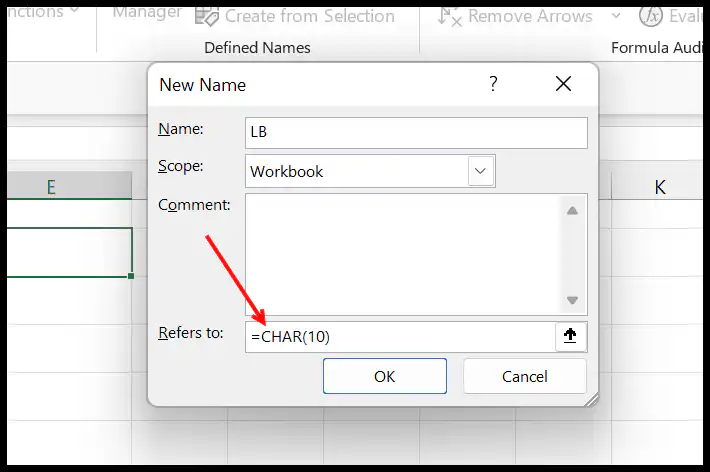
Now, if you want to add a new line in a cell while combining two values, you can simply use a formula like the one below.
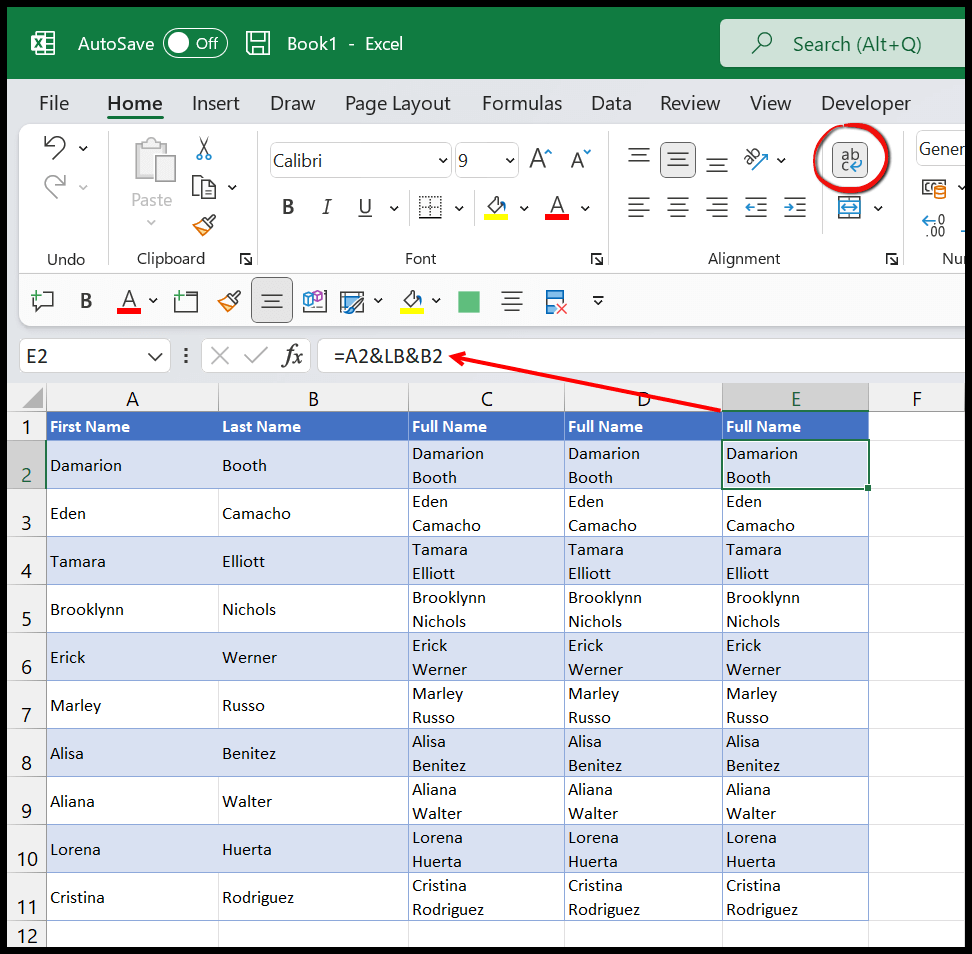
In this method, you also need to apply wrap text to the cell to place the second value on a new line.
Frequently Asked Questions
What is the keyboard shortcut to start a new line in an Excel cell?
Double-click the cell to edit it, then press Alt + Enter at the point where you want the break. On a Mac, the shortcut is Ctrl + Option + Enter (and in some versions, Cmd + Option + Enter). When you use the shortcut, Excel turns on Wrap Text for you automatically.
Why is my line break not showing up in the cell?
Nine times out of ten, it’s because Wrap Text is turned off. When you add a line break with a formula or with Find and Replace, Excel doesn’t enable wrap text for you. Select the cell, go to the Home tab, and click Wrap Text — your second line will appear right away.
What’s the difference between CHAR(10) and CHAR(13)?
CHAR(10) is the line feed character, and it’s the one Excel uses for a new line on Windows. CHAR(13) is the carriage return, which is what you need on Excel for Mac. So if your CHAR(10) formula isn’t breaking the line on a Mac, switch it to CHAR(13).
How do I add a line break inside a formula?
Use the CHAR function with the value 10 and join it between your values. For example, =A2&CHAR(10)&B2 puts the value from B2 on a new line below A2. You can do the same with CONCATENATE or TEXTJOIN — just remember to apply Wrap Text to the column afterward.
How do I remove line breaks from a cell?
You’ve got two easy options. Use =CLEAN(A1) to strip the break out completely, or =SUBSTITUTE(A1,CHAR(10)," ") to replace it with a space. If you’d rather skip the formula, open Find and Replace with Ctrl + H, press Ctrl + J in the “Find what” box, leave “Replace with” empty, and click Replace All.
Does this work the same way in Google Sheets?
Mostly, yes. The Alt + Enter shortcut works in Google Sheets too, and so does the CHAR(10) formula. The one difference is that Google Sheets wraps text by default, so you usually don’t have to turn wrap text on yourself.

Written by
Puneet Gogia
Microsoft MVP — Excel · Founder, Excel Champs
Twelve years of teaching Excel, and a decade before that using it as a data analyst. Every tutorial here is written from a file I actually built.