

To count values greater than zero, use =COUNTIF(A2:A19,">0"). The operator and the number both sit inside one pair of double quotes.
To include zero itself, use ">=0". To pull the threshold from a cell instead of hard-coding it, join with & — =COUNTIF(A2:A19,">"&B1) — which lets you change the cutoff without editing the formula.
For two conditions, switch to COUNTIFS: =COUNTIFS(A2:A19,">0",A2:A19,"<10") counts values between 1 and 9. If the count comes back lower than expected, the usual cause is numbers stored as text — they’re left-aligned in the cell and COUNTIF skips them entirely. Select the column and use Data → Text to Columns → Finish to convert them back to real numbers.
Let’s say you’re a sales manager keeping track of your team’s progress. You’ve got a list of how many sales your store makes every day. Now, you want to see on how many days the store sold something, ignoring the days it didn’t sell anything.
To count values that are greater than zero (0) from a list of values or a range of cells, you can simply use Excel’s COUNTIF function using greater than zero criteria.
Apart from this, in this tutorial, we are going to explore more methods that you can use to count cells above the value zero. So let’s get started…
COUNTIF Greater Than 0 (Formula)
In this example, we have a list with some negative numbers and some positive numbers. Now, you need to count the numbers that are greater than 0.

- First, type “=COUNTIF” and an opening parenthesis in cell C1 where we are going to get the result.

- Next, in the range argument, specify the range (A2:A19) from which you want to count the numbers.
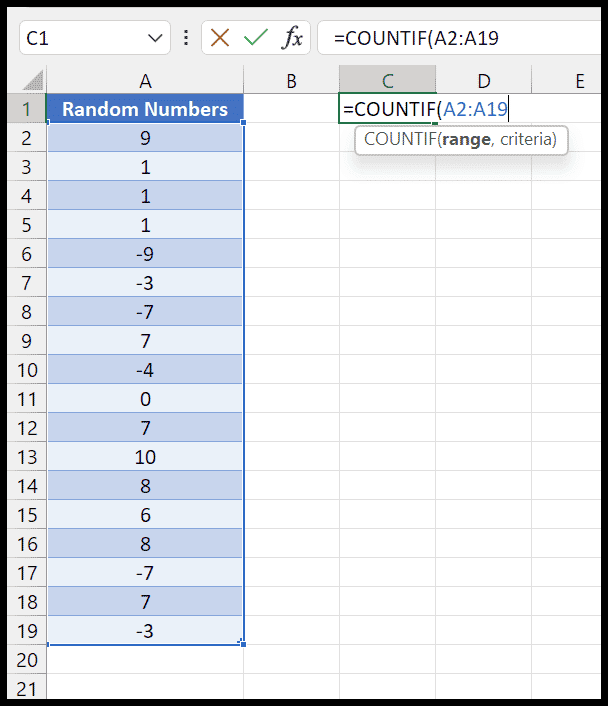
- After that, type a comma to move to the next argument.
- In the end, enter “>0” in the criteria argument and a closing parenthesis.
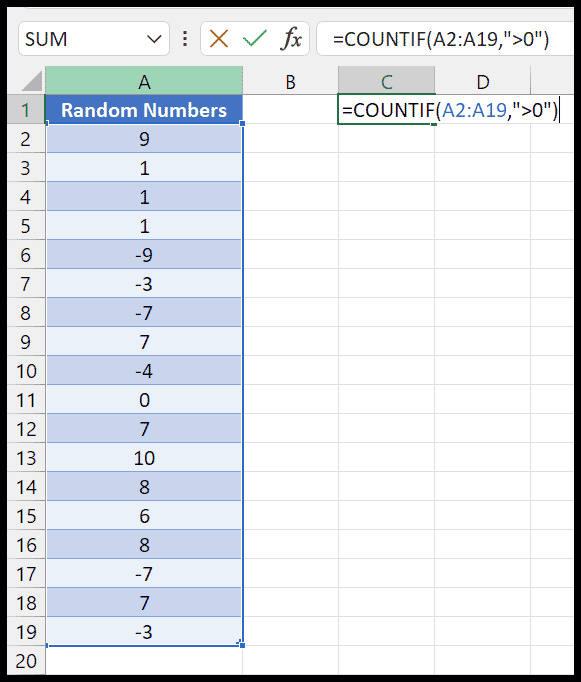
=COUNTIF(A2:A19,">0")
When you press Enter, you will get the result in cell C1. This formula returns 11.
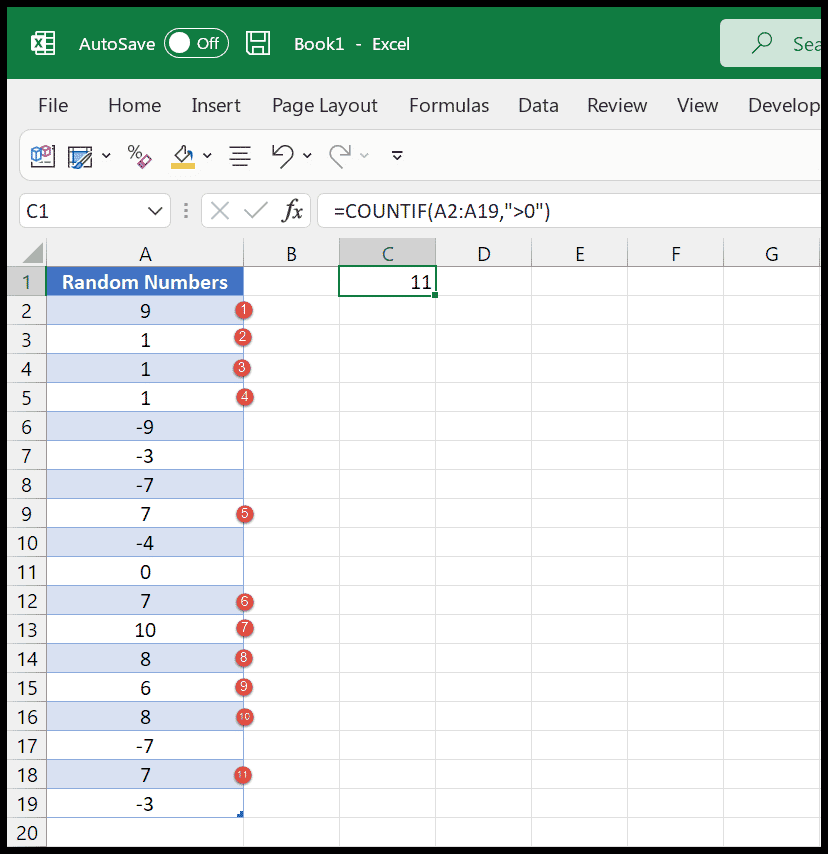
How this Formula Works
To understand this formula, you need to split it into two parts:
- A2:A19: This is the cell range from which we count the values greater than zero. To change this formula per your requirement, you can edit it to match the range in your workbook.
- “>0”: We are applying this criterion to the range. You are telling the formula to count cells with a value greater than zero and ignore all the values below and equal to zero.
IF COUNTIF is Not Working Properly
When the COUNTIF does not work as expected for values greater than 0 or any other value, a few common issues might be the cause. First, ensure that your range has real numbers. COUNTIF ignores text values and empty cells, so numbers stored as text are not counted. Second, check that your criteria are correctly formatted as “>0” or “>”&”0” (including the quotation marks).
Other possible issues include incorrectly referenced ranges and incorrect cell formats. It’s important to ensure the range you are evaluating is correctly referenced in your formula. Also, verify that the cells in your range are formatted as numbers; numbers formatted as text can cause problems.
Read Also: Less Than in Excel
COUNTIFS to Count Greater than Zero and Less than 10 (Multiple Criteria)
If you want to count numbers greater than zero and less than 10 (or any other number), then use the COUNTIFS function. Below is the formula that you can use:
=COUNTIFS(A2:A19,">0",A2:A19,"<10")

This formula is simple yet powerful, so let’s split it into parts and understand it: A2:A19 is our list of numbers. “>0” tells the formula only to count numbers bigger than zero, ignoring the rest.
Then, “<10” adds another rule; it tells the formula only to count numbers less than 10. No matter which formula you are using, make sure to have the values in the column in the right data type. If numbers are stored as text, then COUNTIF and COUNTIFS won’t count them.
Cell Value Vs. Hard Value
When counting values greater than 0, you can directly input the criteria “>0” in the formula or reference a cell containing 0.
Referencing a cell value provides more flexibility, especially if the criteria change. For instance, if cell B1 contains the value 0, you can use:
=COUNTIF(A2:A19, ">" & B1)
If you need to adjust the criteria, you can change the value in cell B1 without altering the formula.
Other Formulas that can COUNT Cells Above Zeros
Yes, there are a few other ways that you can use to count cells above 0.
1. Using SUMPRODUCT
SUMPRODUCT can count the number of cells in the range A2:A19 that contain values greater than zero. This formula below multiplies items in arrays together and then adds them up.
=SUMPRODUCT(--(A2:A19>0))
A2:A19>0 checks if each number in the range is greater than zero, giving us a list of TRUEs and FALSEs. The double minus (“–“) turns the TRUE and FALSE results of (A2:A19>0) into ones and zeros.
So, we end up with 1s for numbers above zero and 0s for numbers equal to or below zero. Finally, SUMPRODUCT adds up all the 1s to get the count of cells above zero as a value.
But there’s a catch. In a comparison, Excel treats any text as greater than any number, so a text value (even a space or a number stored as text) counts as greater than zero here. If your range can have text, add ISNUMBER to count only real numbers:
=SUMPRODUCT(--(A2:A19>0),--ISNUMBER(A2:A19))
On a test list with 9 positive numbers and 3 text values, the first formula returned 12 and this one returned 9.
2. Using COUNT + FILTER
This formula filters the range A2:A19 to only include values greater than zero using the condition A2:A19>0 and then counts the filtered values using the COUNT.
=COUNT(FILTER(A2:A19, A2:A19>0))
FILTER is available in Microsoft 365 and Excel 2021 or later. It takes the values from a range that meet the condition. A2:A19 is the range of numbers we’re looking at. A2:A19>0 checks if each number in the range is greater than zero, and FILTER only keeps those values.
Then, COUNT simply counts the number of numbers left after filtering. So, the formula counts the number of values in the range A2:A19 that are above zero.
3. Using SUM + IF
You can use this array formula to count values above zero. In Excel 2019 and earlier, enter it with Ctrl + Shift + Enter.
=SUM(IF(A2:A19>0,1,0))
The IF function checks each cell in the range A2:A19. If the value in a cell is greater than zero, it returns 1; otherwise, it returns 0. Then, the SUM adds up all the 1s, effectively counting the number of cells with values above zero. Like SUMPRODUCT, it also counts text values as greater than zero, so use it only on a range with numbers.
Read Next
COUNT IF Blank / Excel COUNTIFS Less Than / COUNT IF Not Blank / Excel COUNTIF Not Equal To / COUNTIF OR / COUNTIF Between Two Numbers
Frequently Asked Questions
How do I count cells greater than or equal to zero?
Use “>=0” as the criteria. It counts the zeros as well, and still ignores blank cells and text:
=COUNTIF(A2:A19,">=0")
How do I count values greater than zero with another condition?
Use COUNTIFS with a second range and criteria. This one counts the values above zero where column B has “East”:
=COUNTIFS(A2:A19,">0",B2:B19,"East")
Why does my count include blank cells?
COUNTIF with “>0” never counts truly empty cells. If you get a higher count, the cells aren’t empty: they may have a space or a formula that returns text, and the SUMPRODUCT and SUM IF formulas count those as greater than zero.

If you want to learn more formulas, check out my free formula course.