

The less-than-or-equal-to operator in Excel is <=, typed as two characters with the angle bracket first. Use it directly to compare two cells: =A1<=B1 returns TRUE when A1 is smaller than or equal to B1, and FALSE otherwise. On its own, < tests less than only, so =3<=4 and =3<4 both return TRUE, while =4<=3 returns FALSE.
For a readable result instead of TRUE/FALSE, wrap it in IF: =IF(A1<=B1,"Within budget","Over"). Inside functions that take criteria, the operator goes in double quotes and joins to a cell reference with &: =COUNTIF(A1:A10,"<=50") counts values of 50 or less, and =SUMIF(A1:A10,"<="&C1,B1:B10) sums against whatever is in C1.
That criteria form is where most people actually need it — in COUNTIF, COUNTIFS, SUMIF, SUMIFS, and AVERAGEIF. The operators work on dates and text too: dates compare as numbers, and text compares alphabetically without regard to case.
In Excel, you can use the less than equal to operator for a logical test (test a condition). You combine the less than (<) and equal to (=) signs for this. In this tutorial, we will learn to use it in a formula.

Write a Formula using Less Than or Equal To
- Enter an equal sign to start the formula.
- Refer to the first cell where you have the values to test.
- Type the less than and equal to operator (<=) using your keyboard, with the less than sign first.
- Refer to the second cell where you have the value to test with.
- Hit Enter to get the result.
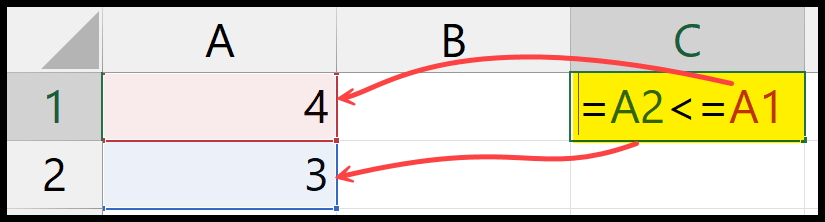
When you use the less than and equal to operator, you need to refer to the cell or enter the value you want to test, then the <= operator and the value or the cell with which you want to test it.
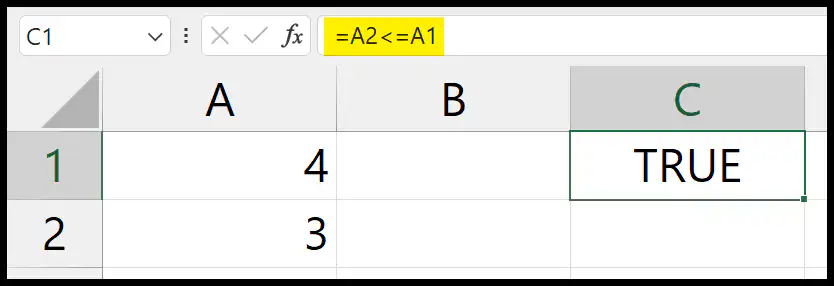
In the example, we compare 3 with the value 4 to check if it is less than or equal to it. It returns TRUE in the result, as 3 is lower than 4.
Here’s the formula from the example, with 3 in cell A1 and 4 in cell B1:
=A1<=B1
It also returns TRUE when both values are the same (4 <= 4), and FALSE only when the first value is greater than the second. Always write the less than sign first (<=), not the other way around.
Using Only Lower Than <
You can also use only the less than operator. It tests if a value is lower than the other one, and it returns FALSE when both values are the same. Using the same example, you can write the formula like this:
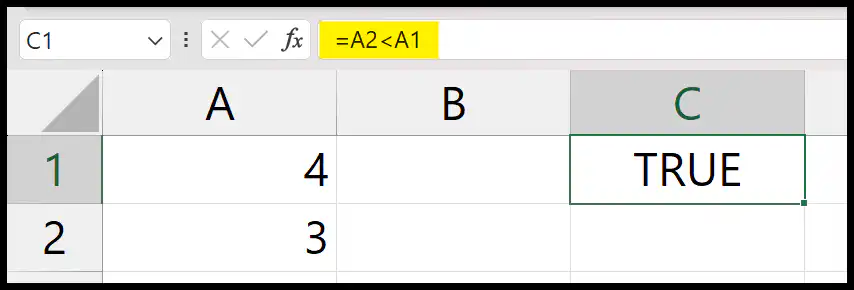
We have the same result here (TRUE), as 3 is a lower value than 4.
=A1<B1
Use Less Than or Equal To with IF
TRUE and FALSE are useful, but most of the time, you want your own result. Use the operator in the condition of the IF function. The following formula returns “Pass” when A1 is less than or equal to B1 and “Fail” when it’s not:
=IF(A1<=B1,"Pass","Fail")
And to test if a value is between two numbers (including both), combine two conditions with AND:
=AND(A1>=50,A1<=100)
Use Less Than or Equal To in COUNTIF and SUMIF
In COUNTIF, SUMIF and the other IFS functions, the operator goes inside double quotes. The first formula counts the values in A2:A10 that are less than or equal to 80, and the second one sums them:
=COUNTIF(A2:A10,"<=80")
=SUMIF(A2:A10,"<=80")
When the value is in a cell, join the operator to the cell with an ampersand (&):
=COUNTIF(A2:A10,"<="&D1)
Text, Dates and Blank Cells
- Text: the operator compares text alphabetically and ignores the case, so =”apple”<=”Banana” returns TRUE.
- Numbers stored as text: in a comparison, text is always greater than a number, so a “5” stored as text is not less than or equal to 4, or even to 100. Convert it to a number first.
- Dates: dates are numbers, so <= checks if a date is on or before another date. Use the DATE function for a date in the formula, like A1<=DATE(2024,12,31).
- Blank cells: an empty cell counts as 0, so it’s less than or equal to any positive number.
Frequently Asked Questions
How do I type the ≤ symbol in a cell?
In a formula, always use <=. To show the ≤ symbol as text, use =UNICHAR(8804), or go to Insert ➜ Symbol. The ≤ symbol doesn’t work as an operator in a formula.
What is the difference between < and <=?
Both return TRUE when the first value is lower. When both values are the same, <= returns TRUE and < returns FALSE.
Why does my formula return FALSE when the number looks smaller?
The value is most likely a number stored as text, which Excel treats as greater than any number. Check it with ISNUMBER, and convert it with VALUE or Text to Columns.
Written by
Puneet Gogia
Microsoft MVP — Excel · Founder, Excel Champs
Twelve years of teaching Excel, and a decade before that using it as a data analyst. Every tutorial here is written from a file I actually built.