

For everyday sheets, keep the default font (Aptos Narrow in Microsoft 365, Calibri in older versions) or switch to Segoe UI or Arial. All of them stay clear at 10–11 pt and are already on every Windows PC.
Verdana is very readable but wide, so columns need more width and #### appears sooner. For codes, IDs and fixed-width layouts, a monospaced font such as Consolas, which ships with Windows, keeps every character the same width.
To change the font for the whole workbook, go to Page Layout → Fonts → Customize Fonts and set the body font. To use it in every new workbook, set it under File → Options → General → Use this as the default font and restart Excel.
Fonts don’t travel with the file. A downloaded font such as Fira Code or Source Code Pro shows up as a substitute on any PC that doesn’t have it installed, which can shift column widths and break the layout. For shared files, stick to fonts that come with Windows and Office.
In Excel, when you are working with data, it’s important to use a font that presents that data in a way that’s easy for the user to understand. The default font in Excel is Aptos Narrow with a font size of 11 in Microsoft 365 (older versions use Calibri 11), but you can use any of the fonts you want.
In this tutorial, I’ll share five different fonts that I have found to be good replacements for the default font.
1. Segoe UI
I have found Segoe UI to be a perfect replacement for the default font. This font is already installed in Windows. You just need to change it from the Home Tab ⇢ Font.

2. Fira Code
Fira Code is a Google font that you can download and install on your system. I have found this good to use when I need to present numbers. It’s a monospaced font (every character has the same width), so digits line up neatly in a column and are easy to read.

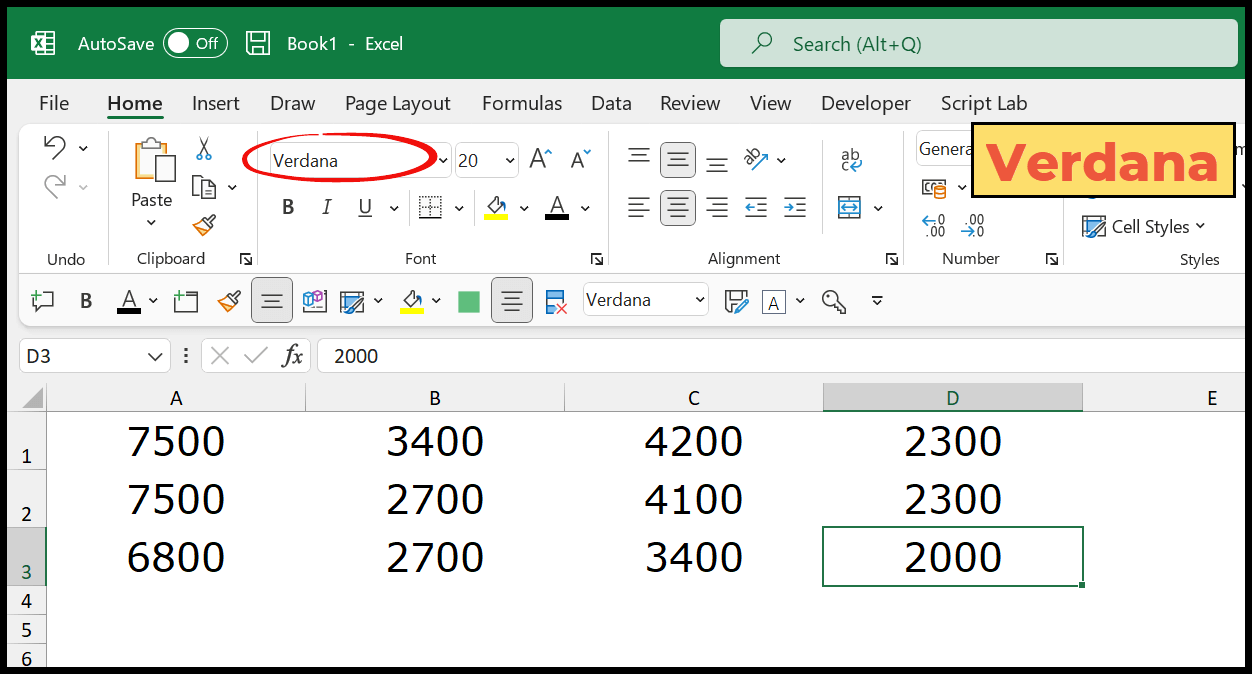
3. Verdana
Verdana is a pre-installed font in Windows and one of the most used fonts in the world. I use this font when I am working on large data sets. Its wide, clear letters make it very easy to read, and you can use it in reports as well.
4. Helvetica
Helvetica is a pre-installed font on Mac, and you can use it in Excel too. It isn’t installed with Windows, where Arial is the closest built-in match. This font works perfectly with large data sets and especially with column headings.

5. Source Code Pro
Source Code Pro is also a Google font that you need to download and install on your system. Like Fira Code, it’s monospaced. It’s a sleek font that can be used in dashboards and reports, especially when you need to use a large font size.

In this list, I have only recommended sans-serif fonts. Excel is a spreadsheet application, and when you are working with data, a font style needs to be easily understandable for the user.
A Few More Fonts Already on Your Computer
- Aptos: Microsoft’s newer default font family in Microsoft 365. Aptos Narrow fits more text in a column, and Aptos is a little wider.
- Arial: installed on both Windows and Mac, so it looks the same for everyone you share the file with.
- Consolas: a monospaced font that comes with Windows and Office, like Fira Code but with nothing to install.
Use a Font That Others Also Have
A font is not saved inside the workbook. If you use Fira Code or Source Code Pro and send the file to someone who doesn’t have that font, Excel shows another font on their computer, and your columns may not fit as you planned. For files you share, stick to fonts that come with Windows, Mac and Office, like Segoe UI (Windows), Verdana, Arial or Aptos.
Make Your Favorite Font the Default
- First of all, go to File ➜ Options ➜ General.
- After that, under “When creating new workbooks”, pick your font in “Use this as the default font” and set the font size.
- In the end, click OK and restart Excel. The new font is used for every new workbook, while existing workbooks keep their font.
Frequently Asked Questions
What is the default font in Excel?
In Microsoft 365, it’s Aptos Narrow, size 11. Excel 2021 and older versions use Calibri, size 11.
Which font is best for numbers in Excel?
A font where all digits have the same width keeps numbers lined up in a column. Monospaced fonts like Consolas, Fira Code and Source Code Pro do this for every character, and most standard fonts like Aptos, Calibri and Arial also use same-width digits.
Why does my font look different on another computer?
That computer doesn’t have the font installed, so Excel uses a different one in its place. Install the font there, or use a font that comes with Windows and Office.