

Click any cell in the pivot, go to PivotTable Analyze → Select → Entire PivotTable and press Delete. That removes the whole pivot, including any filters above it, and leaves the source data as it was.
If the pivot is the only thing on its sheet, right-click the sheet tab and choose Delete instead. You can’t undo a sheet deletion with Ctrl + Z, so check the sheet first.
To keep the figures but lose the pivot, select the entire pivot the same way, press Ctrl + C, and paste over the same cells with Home → Paste → Paste Values (Alt, H, V, V). Choose Values & Source Formatting instead to keep the pivot’s look.
To empty the pivot but keep it for a new layout, use PivotTable Analyze → Clear → Clear All. To remove every pivot in the workbook, run this macro; it clears each pivot’s range without shifting the cells around it.
Sub DeleteAllPivotTables()
    Dim ws As Worksheet
    Dim i As Long
    For Each ws In ThisWorkbook.Worksheets
        For i = ws.PivotTables.Count To 1 Step -1
            ws.PivotTables(i).TableRange2.Clear
        Next i
    Next ws
End Sub
If Excel says “Cannot change this part of a PivotTable report”, only part of the pivot was selected; use Select → Entire PivotTable rather than dragging over the cells. Once the pivot is gone, any GETPIVOTDATA formulas that pointed at it return #REF!, and a linked PivotChart becomes a static chart.
Once you become a pro at creating reports and data analysis with pivot tables, you might need to delete a pivot table to make new reports.
Steps to Delete a Pivot Table in Excel
If you’re looking to remove a pivot table from your worksheet, here are some detailed steps to guide you through the process:
- First, click anywhere on the pivot table you want to delete and activate the PivotTable Analyze tab (Analyze in older versions).

- Now, look for the “Select” drop-down in the “Actions” group.

- After this, click on the little drop-down to select “Entire PivotTable”.

- The moment you click on the “Entire PivotTable” option, your entire pivot table will be selected.
- In the end, press the Delete key on your keyboard.
If you get the message “Cannot change this part of a PivotTable report”, only a part of the pivot table is selected. Click inside the pivot table, press Ctrl + A to select the whole of it, and press Delete again. And if the pivot table is on its own sheet with nothing else you need, simply delete that sheet.
Reset a Pivot Table Instead of Removing It
Just follow the quick steps below to reset all the pivot table fields.
- First, click anywhere on the pivot table or select the entire pivot table.
- Now, go to the PivotTable Analyze tab.
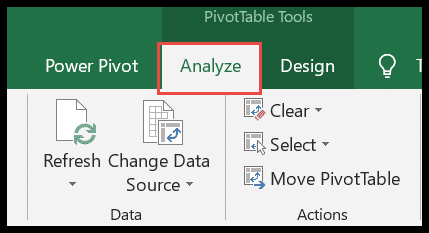
- Here, click on the little arrow on the Clear button.
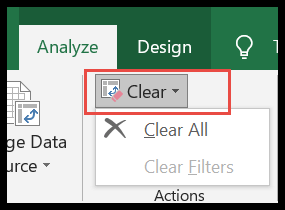
- At last, click on “Clear All”.

When you click the “Clear All” option button, you will get a blank pivot table again.

This option doesn’t delete the pivot table completely but removes all the fields you used to build it (rows, columns, values and filters).
Delete the Pivot Table But Keep the Values
If you want to delete a pivot table but want to keep the values, here’s a step-by-step guide to help you:
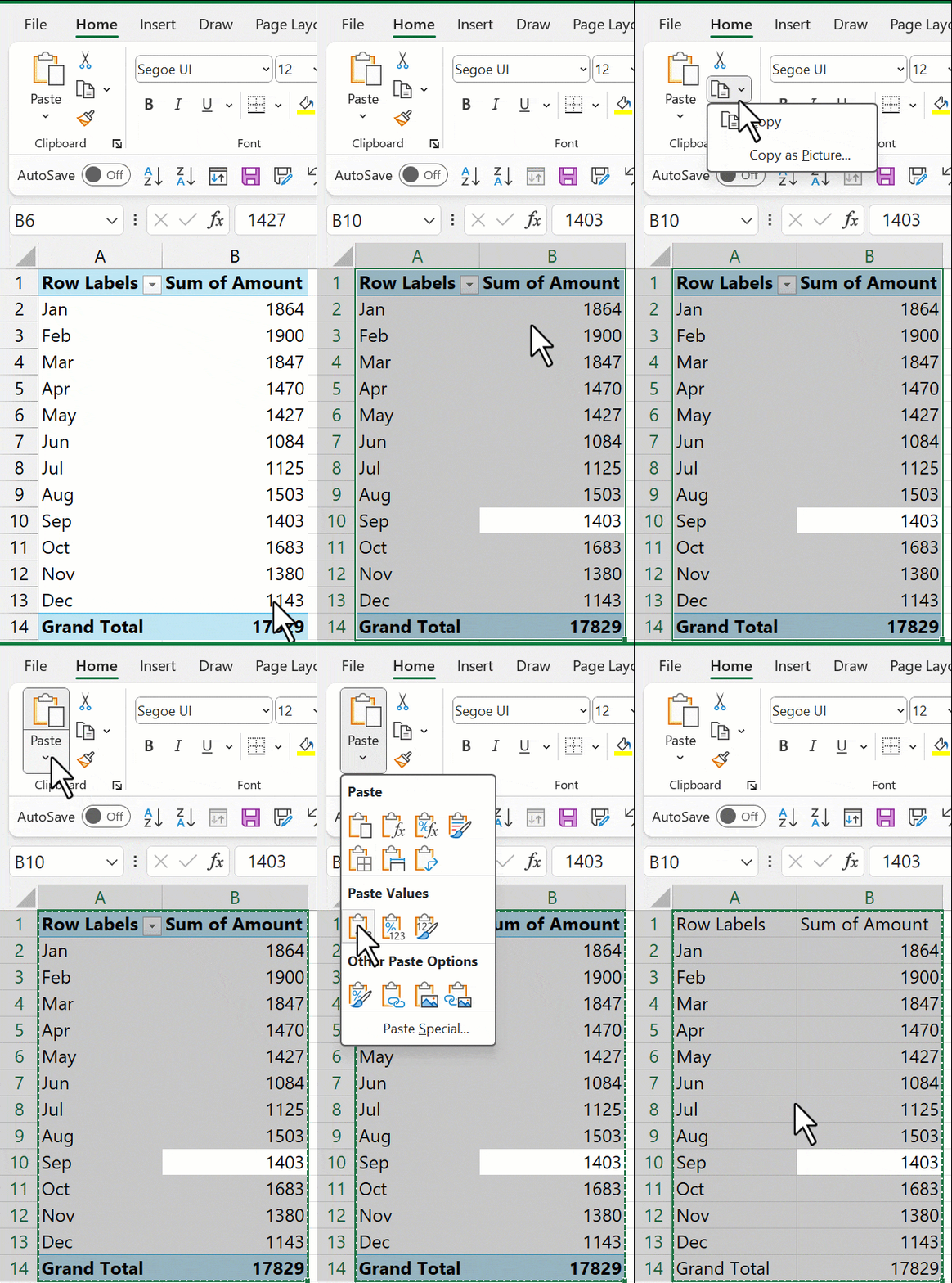
- Select the Pivot Table: Select a cell within the pivot and press Ctrl + A on your keyboard twice. The first press will select the pivot table’s data area, and the second will select the entire pivot, including the headers.
- Copy the Pivot Table: You should copy it once the pivot table is selected. Press the keys Ctrl + C on your keyboard to copy the pivot table. This action will copy all the contents of the pivot table, including all its data and formatting.
- Select the Paste Location: After copying the pivot table, you need to select the location where you want to paste the values. To do this, click on the cell where you want the data to start.
- Paste As Values: Under the Home tab, look for the Paste button and click on the arrow below it. Select the Paste Values option from the dropdown menu. This option will paste the data from the pivot table as hard values without any of the pivot table functionalities.
When using this method, paste the values first and then delete the pivot table, so you only keep the values. You can also paste the values right over the pivot table itself to replace it in place. You can use the keyboard shortcut Ctrl + C to copy and Alt > H > V > V to paste values.
Delete All the Pivot Tables with a Macro (VBA Code)
To run the below code, open the Visual Basic Editor from the Developer tab (or press Alt + F11), insert a module and paste the code into it:
Sub RemoveAllthePivotTables()
Dim mySheet As Worksheet
Dim myPivot As PivotTable
On Error Resume Next
For Each mySheet In ActiveWorkbook.Worksheets
    For Each myPivot In mySheet.PivotTables
        mySheet.Range(myPivot.TableRange2.Address).Delete Shift:=xlUp
    Next myPivot
Next mySheet
End Sub
This code will remove the pivot tables from all the worksheets in the active workbook.
How this Code Works
Here’s a line-by-line explanation of the above code:
Dim mySheet As WorksheetandDim myPivot As PivotTable: These lines declare two variables. mySheet is an object variable that represents each worksheet in the workbook, and myPivot is an object variable representing each pivot table on a worksheet.On Error Resume Next: This line allows the code to continue running even if it encounters an error, for example, when a pivot table can’t be deleted because it’s on a protected sheet. (A sheet without pivot tables doesn’t cause an error; the inner loop just doesn’t run.)For Each mySheet In ActiveWorkbook.Worksheets: This line starts a loop that will go through all the worksheets in the active workbook.For Each myPivot In mySheet.PivotTables: This line starts a nested loop through each pivot table on the current worksheet.mySheet.Range(myPivot.TableRange2.Address).Delete Shift:=xlUp: This line deletes the entire range of cells occupied by the current pivot table (TableRange2 includes the report filters). The Shift:=xlUp part causes the cells below the deleted range to shift up to replace the deleted cells, preventing blank rows from being left in the worksheet.
Deleting items from a collection while a For Each loop goes through it can skip some of them, so a sheet with two or more pivot tables may still have one left after the first run. The following version loops backwards and clears each pivot table’s range, so nothing is skipped and the cells around it don’t move:
Sub ClearAllPivotTables()
    Dim mySheet As Worksheet
    Dim i As Long
    For Each mySheet In ActiveWorkbook.Worksheets
        For i = mySheet.PivotTables.Count To 1 Step -1
            mySheet.PivotTables(i).TableRange2.Clear
        Next i
    Next mySheet
End Sub
Points to Take Care Before You Delete a Pivot Table
Before you delete a pivot table, it’s important to check that:
- Verify that you have selected the correct pivot table.
- Remember that deleting a pivot table does not delete the original data. However, changes in the pivot table, like calculated fields and items, will be lost.
- Ensure that no other data or formulas in your worksheet are linked or connected to the pivot table you want to delete. Deleting the pivot table may cause errors in these cases (for example, GETPIVOTDATA formulas return #REF!).
- Consider copying the pivot table and pasting it as values in another location to preserve the table format and analysis without keeping the pivot functionalities.
If the pivot table has a PivotChart, deleting the pivot table doesn’t delete the chart. The chart stays, but it’s no longer connected to a pivot table, so it no longer updates. Delete the chart separately if you don’t need it.
Frequently Asked Questions
Does deleting a pivot table delete the source data?
No. The source data stays as it is. Only the pivot table report (and anything you added inside it, like calculated fields) is removed.
Why can’t I delete part of a pivot table?
Excel doesn’t let you delete single cells or rows inside a pivot table. Remove a field from the PivotTable Fields pane, filter out the item, or select the entire pivot table to delete it.
Can I undo deleting a pivot table?
Yes, if you deleted it manually, press Ctrl + Z right away. A pivot table deleted with a macro can’t be undone, so save the workbook before you run the code.