

Percentages are stored as decimals — 30% is really 0.3 — so ROUND’s digit count works on the decimal, not on what you see. That means you need two more digits than you’d expect: =ROUND(A1,2) gives a whole percentage (30%), =ROUND(A1,3) gives one decimal place (30.5%), and =ROUND(A1,4) gives two (30.49%).
Once you know that, the rest follows: =ROUNDDOWN(A1,2) always rounds down to a whole percent, =ROUNDUP(A1,2) always rounds up. For the nearest 5%, use =MROUND(A1,5%).
And if you only want the figure to display rounded while keeping the exact value for calculations, don’t use a formula — select the cells and click Decrease Decimal on the Home tab, or set a custom format like 0%.
That matters on any sheet where the percentages get totalled, since a column of rounded values often won’t add to exactly 100%.
Just like numbers, you can round percentage values in Excel. A percentage is a decimal number that is formatted as a percentage. 100% means a number value of 1. To round percentages, you can use the ROUND, ROUNDUP, and ROUNDDOWN functions. In this tutorial, you will learn to write a formula for this.
Round Percentage with ROUND Function
The below example shows the percentage values 30.49% and 30.50%. Now, when you use the ROUND function with 2 for num_digits, it rounds the first percentage value to 30% and the second to 31%.

In the first value, you have .49 after the decimal point of the percentage, which is why it rounds to 30%. And in the second value, you have .50, so it rounds to 31%.
=ROUND(A1,2)
Why 2 and not 0? Because 30.49% is stored as 0.3049. To round to a whole percentage, you need two decimal places of the stored value, to one decimal of the percentage, three, and so on.
Round Percentage to One Decimal
If you want to round a percentage value to one decimal, you need to use a formula just like the following:
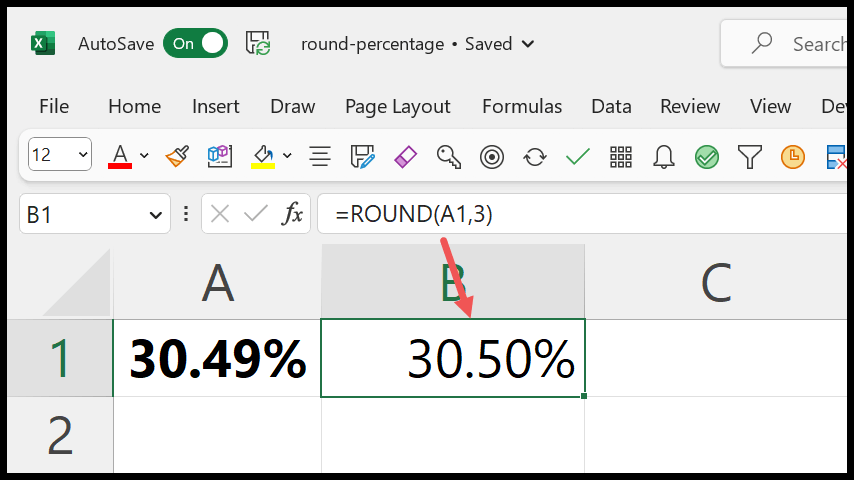
=ROUND(A1,3)
In this formula, we have used 3 in the num_digits argument, which allows you to round the percentage with one decimal left (30.49% becomes 30.5%).
Round Down the Percentage
If you want to round down a percentage, you can use ROUNDDOWN, just like in the below example, where you have the percentage 30.49%.

=ROUNDDOWN(A1,2)
=ROUNDDOWN(A2,3)
In the first formula, you have 30.49%, and we have used 2 as num_digits to round. It returns 30.00%. And in the second formula, you have 30.49%, and we have used 3 as num_digits to round. It returns 30.40% in the result.
Round Up the Percentage
In the same way, you can use ROUNDUP to round the percentage upwards. With 30.49%, 2 as num_digits returns 31%, and 3 returns 30.5%.

=ROUNDUP(A6,2)
=ROUNDUP(A7,3)
Remove the Decimal Part from a Percentage
There might be a situation when you need to get rid of the decimal in the displayed result. You can consider the below formula for this:
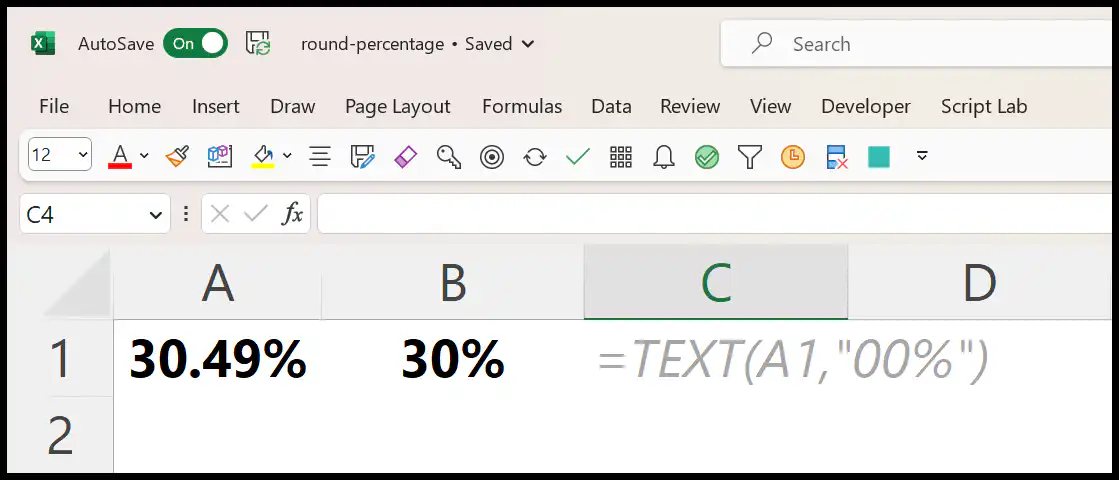
=TEXT(A8,"0%")
TEXT rounds the value (30.5% shows as 31%) and returns it as text, so you can’t use the result in other calculations. If you need a number without the decimal part, use ROUNDDOWN(A8,2) or TRUNC(A8,2) instead, and format the cell as a percentage.
Round a Percentage to the Nearest 5%
To round to a step like 5% or 10%, use MROUND with the step as the second argument. For 30.49%, the following formula returns 30%:
=MROUND(A1,5%)
Rounding vs Decrease Decimal
The Decrease Decimal button on the Home tab (or Format Cells ➜ Percentage ➜ Decimal places) only changes how the percentage looks. The cell still holds the full value, so a SUM of those cells can look off by 1%. Use ROUND when the rounded value itself should be used in calculations.
Frequently Asked Questions
Why does ROUND(A1,0) return 0% for a percentage?
Because 30.49% is 0.3049, and rounding that to zero decimals gives 0. Use 2 as num_digits for whole percentages.
What if my percentages are typed as whole numbers?
If a cell holds 30.49 (not 30.49%), it’s a plain number, so use 0 as num_digits to round it to 30, like =ROUND(A1,0).
How do I make rounded percentages add up to 100%?
Rounded parts don’t always add up to exactly 100%. A simple fix is to round all but the last value and calculate the last one as 100% minus the sum of the others.
Written by
Puneet Gogia
Microsoft MVP — Excel · Founder, Excel Champs
Twelve years of teaching Excel, and a decade before that using it as a data analyst. Every tutorial here is written from a file I actually built.