

CONCATENATE can’t accept a range — point it at A1:A5 and it returns only the first cell. Use TEXTJOIN instead: =TEXTJOIN(" ",TRUE,A1:A5) combines the whole range with a space between each value, and the TRUE skips blanks.
Change the first argument for a different separator — “, ” for a comma-separated list. If you don’t need a separator at all, =CONCAT(A1:A5) runs the values together.
Both need Excel 2019 or later; standalone Excel 2016 has neither. On older versions the practical options are a helper approach with &, or Power Query’s Merge Columns, which has the advantage of updating on refresh when you add rows.
Two no-formula routes worth knowing: Home → Editing → Fill → Justify merges a selected column of text into the top cell in one click, and Power Query handles it repeatably. Note that Fill Justify and the CONCATENATE+TRANSPOSE+F9 trick both produce static text — they don’t update when the source cells change.
Combining values with CONCATENATE is the best way, but with this function, it’s not possible to refer to an entire range. You need to select all the cells of a range one by one, and if you try to refer to an entire range, it will return the text from the first cell.
In this situation, you do need a method where you can refer to an entire range of cells to combine them in a single cell. Today in this post, I’d like to share with you 5 different ways to combine text from a range into a single cell.
[CONCATENATE + TRANSPOSE] to Combine Values
The best way to combine text from different cells into one cell is by using the transpose function with concatenating function.
Look at the below range of cells where you have text, but every word is in a different cell, and you want to get it all in one cell. Below are the steps you need to follow to combine values from this range of cells into one cell.
- In the B8 (edit the cell using F2), insert the following formula, but do not press Enter.
- =CONCATENATE(TRANSPOSE(A1:A5)&” “)
- Now, select the entire inside portion of the concatenate function and press F9. It will convert it into an array.
- After that, remove the curly brackets from the start and the end of the array.
- In the end, hit enter.

That’s all.
Note that every value gets a space after it, so the result has one extra space at the end. And in Microsoft 365, you don’t need the F9 step: CONCAT with TRANSPOSE works as a normal formula (formula below).
=TRIM(CONCAT(TRANSPOSE(A1:A5)&" "))
How this formula works
In this formula, you have used TRANSPOSE and space in the CONCATENATE. When you convert that reference into hard values it returns an array. In this array, you have the text from each cell and a space between them and when you hit enter, it combines all of them.
Combine Text using the Fill Justify Option
Fill justify is one of the unused but most powerful tools in Excel. And whenever you need to combine text from different cells, you can use it. The best thing is that you need a single click to merge text. Have a look at the below data and follow the steps.
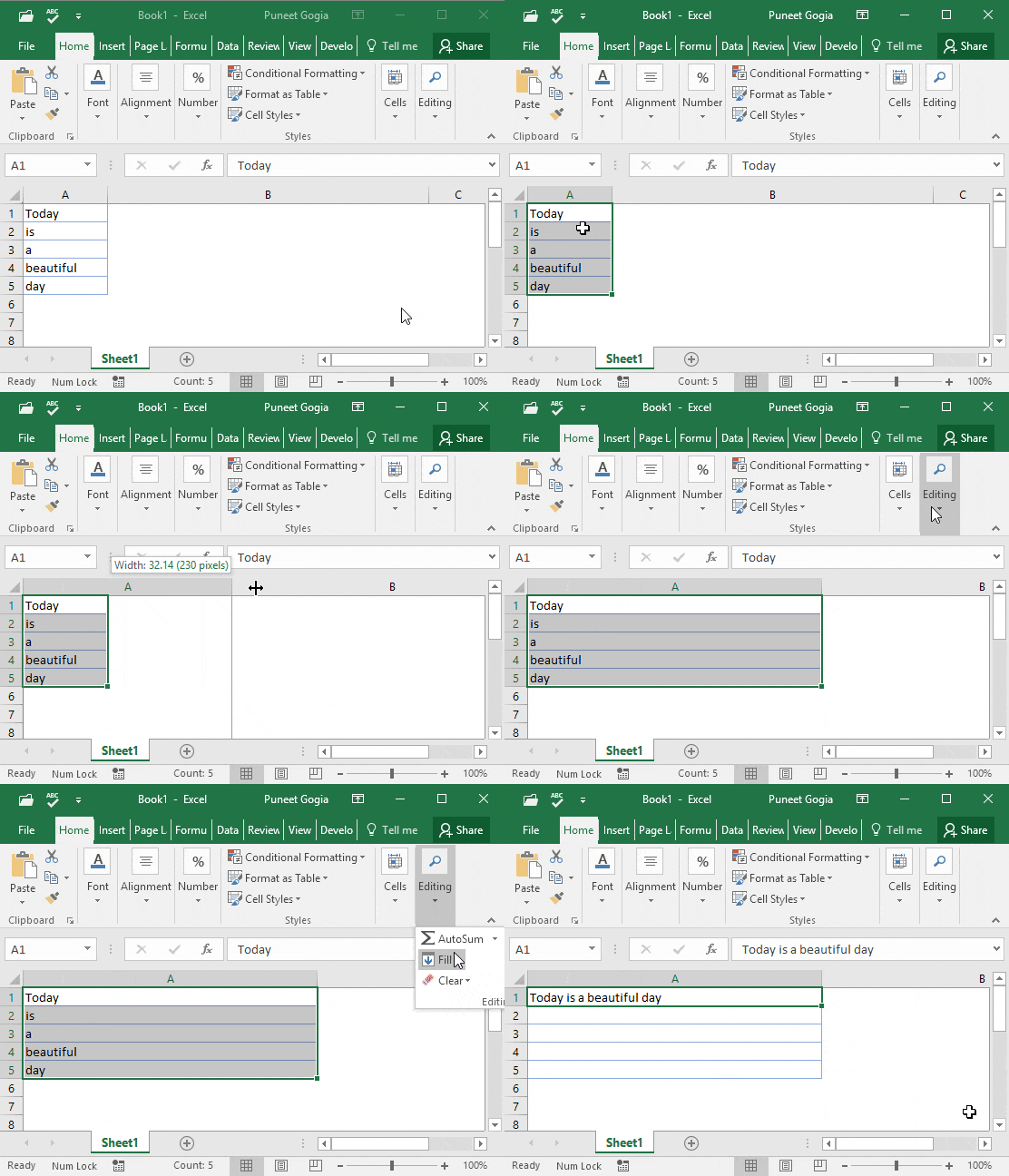
- First of all, make sure to increase the width of the column where you have text.
- After that, select all the cells.
- In the end, go to Home Tab ➜ Editing ➜ Fill ➜ Justify.
This will merge text from all the cells into the first cell of the selection.
Fill Justify works only with text values in a single column. It doesn’t combine numbers or formulas, and if the combined text is wider than the column, Excel splits it again into more than one cell. That’s why you need to make the column wide enough first.
TEXTJOIN Function for CONCATENATE Values
If you are using Excel 2019 or later (or Microsoft 365), there is a function called “TextJoin”. It can make it easy for you to combine text from different cells into a single cell.
Syntax:
TEXTJOIN(delimiter, ignore_empty, text1, [text2], …)
- delimiter: a text string to use as a delimiter.
- ignore_empty: TRUE to ignore blank cells, FALSE to include them.
- text1: text to combine.
- [text2]: more text to combine (optional).
How to Use It
To combine the below list of values you can use the formula:
=TEXTJOIN(" ",TRUE,A1:A5)
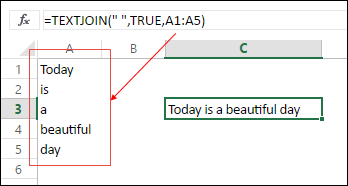
Here you have used a space as the delimiter, TRUE to ignore blank cells, and the entire range in a single argument. In the end, hit Enter, and you’ll get all the text in a single cell.
To separate the values with a comma instead of a space, change the delimiter:
=TEXTJOIN(", ",TRUE,A1:A5)
And if you want to combine only the values that meet a condition, use IF inside TEXTJOIN. The following formula combines the values from A1:A5 where column B has “Yes” (in Excel 2019, press Ctrl + Shift + Enter):
=TEXTJOIN(", ",TRUE,IF(B1:B5="Yes",A1:A5,""))
Combine Text with Power Query
Power Query is a fantastic tool and I love it. Make sure to check out this (Excel Power Query Tutorial). You can also use it to combine text from a list in a single cell. Below are the steps.
- Select the range of cells and click on “From Table/Range” in the Data tab.

- It will load your data into the Power Query editor.
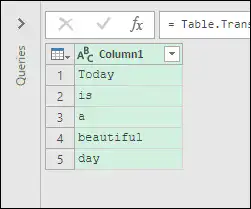
- Now from here, select the column and go to “Transform Tab”.
- From “Transform” tab, go to Table and click on “Transpose”.

- Next, select all the columns (select the first column, press and hold the Shift key, and click on the last column), right-click, and then select “Merge Columns”.

- After that, from the Merge Columns window, select Space as the separator and name the column.

- In the end, click OK and click on “Close & Load”.
Now you have a new worksheet in your workbook with all the text in a single cell. The best thing about using Power Query is you don’t need to do this setup again and again.
When you update the old list with a new value, you need to refresh your query, and it will add that new value to the cell.
VBA Code to Combine Values
If you want to use a macro code to combine text from different cells, then I have something for you. With this code, you can combine text in no time. All you need to do is, select the range of cells where you have the text and run this code.
 Sub combineText()
 Dim rng As Range
 Dim i As String
 For Each rng In Selection
 i = i & rng & " "
 Next rng
 Range("B1").Value = Trim(i)
 End Sub
Make sure to specify your desired location in the code where you want to combine the text.
This code adds a space after every cell, including blank cells, so blank cells in the selection give you double spaces in the result. If you’re on Excel 2019 or later, you can use WorksheetFunction.TextJoin in VBA, which skips the blank cells:
Sub combineTextJoin()
    Range("B1").Value = WorksheetFunction.TextJoin(" ", True, Selection)
End Sub
Which Method to Use
- TEXTJOIN: the best choice in Excel 2019, 2021 and Microsoft 365, as it updates when the values change and lets you pick a delimiter.
- CONCATENATE + TRANSPOSE: for older versions, but the result is fixed text after you press F9.
- Fill Justify: a quick one-time merge of text cells in one column.
- Power Query: when the list keeps growing, and you want to refresh the result.
- VBA: when you combine text from different selections again and again.
In the end,
There may be different situations for you where you need to concatenate a range of cells into a single cell. And that’s why we have these different methods.
All methods are easy and quick; you need to select the right method as per your need. I must say, give all the methods a try once and tell me:
Which one is your favorite and worked for you?
Please share your views with me in the comment section. I’d love to hear from you, and please, don’t forget to share this post with your friends, I am sure they will appreciate it.
Frequently Asked Questions
Why does CONCATENATE not work with a range?
CONCATENATE takes each value as a separate argument, so it can’t combine a whole range into one value. Use CONCAT or TEXTJOIN instead, which accept a range.
What is the difference between CONCAT and TEXTJOIN?
CONCAT joins the values without anything between them. TEXTJOIN lets you add a delimiter, like a space or a comma, and can skip blank cells.
How do I keep the number format when combining?
Formulas combine the underlying values, so dates and currencies lose their format. Wrap them in TEXT, like TEXT(A1,”dd-mmm-yyyy”), before you combine them.

Hello Sir,
first of all would like to say thankful to you because few days ago I have been working on your blogs all are most important and helpful for us again thank you so much sir
Regards
Sandeep Singh
Hi Puneet, when I try to combine cells using formula Concatenate with separater “; “ it returns “\” instead of “,” after I hit F9. Does it have something to do with Excel settings? I tried it at my collegue’s PC and it works as it should and we both use Excel 2010
You mean “;” instead of a ” “?
There were very useful tips. Thanks a lot. TEXTJOIN was something new I learned today. It was really handy.
I’m glad you liked it.
I tried 3 of these with partial success.
* When I do the CONCATENATE(TRANSPOSE) one and hit F9 to create the array, it puts a semicolon between each character instead of a comma. Then I have to change all of them to commas for it to work correctly.
* JUSTIFY just did nothing at all.
* And when I tried TEXTJOIN it seemed to confuse my computer. It doesn’t seem to know what TEXTJOIN means.
Any suggestions? (I’m using Excel 2010)
With justify, you need to make the cells (where you text) enough wide so that the entire text can be merged into one cell.
Ahhh, the text has to be arranged in a column for it to work! That appears to be the fastest option, but can it be done with Justify on text across a row?
One possible answer to the first problem – of a semi-colon instead of a comma – is explained in this article (easier than writing it out here ;-} ) .. https://www.excel-exercise.com/comma-or-semicolon-in-excel-formula/
As you’re using Excel 2010, TEXTJOIN will not exist – you need Excel 2016 (365 version specifically, the standalone Excel 2016 doesn’t have it either [which annoys me!]). I’m not sure when JUSTIFY was added as an Excel formula. I think you need to upgrade your Excel.
All of the them are simple and fast…Thanks
Dear Puneet,
Thanks so much for this. These are very useful time and labor saving methods !
Keep up the good work Sir !
Thanks for your words, Rajiv
AHHH Justify! So helpful!!! Thank you!!!!
You’re Welcome, Kelly.
Simply superb
Thanks for your words, Krishna.
Good Tutorial. First two methods are good. Still, the 2nd option is the best. I am using Excel 2007.
Yes, I can say that Fill Justify is the fastest way to combine text.
In cell A1 there is 5.20
Cell B1 there is 5.26
and In Cell C1 there is 5.30
when I combine these three cells using formula Concatenate with separater “-” It will shows result “5.2-5.26-5.3” instead of 5.20-5.26-5.30. Can you please guide how do I do?
TEXTJOINT – Awesome
Yes, that’s right.
this site is always helpful. Every time I learn new thing one I come here.
Thanks you so much
Thanks for your Words. 🙂
Power Query method worked great, thanks.
Power Query is the real Power.
great!!! thank you sooo much..
You’re Welcome.
Justify method is awesome…
I’m so glad you liked it. 🙂
I am working with Spanish version. When I follow your instructions, after F9 I get:
=CONCATENAR({“Today “”is “”a “”beautiful “”day “})
After removing curly brackets, In order to obtain the correct result, we must change “” by “&”. This was the only way it worked for me.
Please correct me case I was wrong.
Thanks. Very interesting article.
Carlos.
You are right, / is not a concatenation operator.
Hello Puneet,
I like to use the macro. It works like a charm. Thank you.
That’s great.
This is great!
I would (never) would have thought of these solutions (mainly the Concatenate one).
Thanks.
I’m so glad to hear this.
Very nice guidance on concatenate function. I liked and found useful for me with the transpose function. Thanks a lot!
You’re welcome.
Thanks for sharing
I’m so glad you liked it. 🙂
Very very useful information sir
I’m so glad you liked it.
fantastic knowledge
I’m so glad you liked it. 🙂