

Double-click the cell (or press F2), select the characters to raise, press Ctrl + 1, then Alt + E to tick Superscript, and press Enter. Excel has no single-key superscript shortcut; this is the quickest keyboard route.
To raise everything in the cell, select the cell without entering edit mode, press Ctrl + 1, open the Font tab and tick Superscript.
Superscript on part of a cell only sticks when the cell holds text. If the cell holds a number, such as 102 meant as 10², Excel drops the formatting when you press Enter. To show a unit after a number and still be able to sum it, use a custom number format such as 0" m²" under Ctrl + 1 → Number → Custom.
For ² and ³ you do not need formatting: hold Alt and type 0178 or 0179 on the numeric keypad. In a formula, use ="m"&UNICHAR(178) to return m² (UNICHAR needs Excel 2013 or later); 185 gives ¹ and 8308 to 8313 give ⁴ to ⁹.
A cell that contains a typed ² is text, so it will not calculate, and a formula result cannot carry superscript on part of its text. Keep the number in its own cell, or use the custom format above, when you need it in sums.
Latest Video Tutorial – 10 Excel Keyboard Shortcuts (Probably YOU are NOT Using)
Superscript is a text formatting used to move any text or numbers slightly above the rest of the text in the cell.
Superscript in Excel can be used to present copyright and trademark symbols and other symbols like ©, TM, *, units like Sqm2 and cm2, and ordinal numbers like 1st and 2nd.
Keyboard Shortcut for Superscript in Excel
In Excel, to use Superscript, you have to use the combination of the below keys, as Excel does not have a single shortcut for it.
Ctrl + 1, and then, Alt + E → Enter
Steps to Use Superscript Using Keyboard Shortcut
- First, double-click on the cell and select only the text that you want to use as Superscript.
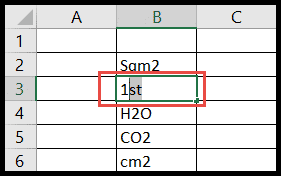
- After that, press the “Ctrl + 1” keys, and you will get the “Format Cells” dialog box opened.
- Now, press the “Alt + E” keys to tick the Superscript option.

- In the end, press the “Enter” key and your selected text will be moved slightly above the rest of the characters in the cell.
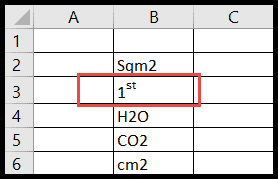
On a Mac, press Command + 1 to open the Format Cells dialog box, then tick Superscript and click OK.
Things to Know About Superscript
- Only text values: you can apply superscript to part of a text value. You can’t apply it to part of a number or to the result of a formula. For a number like 102, type an apostrophe first (‘102) so Excel stores it as text, and then format the 2.
- Whole cell: if you select the cell instead of part of the text, the superscript applies to the whole cell.
- Quick Access Toolbar: in Microsoft 365, you can add the Superscript and Subscript commands to the Quick Access Toolbar (they are in Commands Not in the Ribbon) and use them with one click.
- Remove superscript: select the same characters, press Ctrl + 1, and untick Superscript.
Superscript with a Formula
If you need a superscript inside a formula result, like a unit, use the Unicode superscript characters with the UNICHAR function (Excel 2013 and later). UNICHAR(178) is ² and UNICHAR(179) is ³, so the following formula adds m² to a value in A1:
=A1&" m"&UNICHAR(178)
The result is text, so you can’t use it in further calculations. You can also type ² directly with Alt + 0178 on the numeric keypad.
Frequently Asked Questions
Why is the Superscript option greyed out or not working?
You are probably applying it to a number or a formula. Superscript formatting works only on text that you type in the cell, so convert the number to text or use the UNICHAR formula above.
Is there a one-key shortcut for superscript in Excel?
No. Excel for Windows doesn’t have a direct shortcut like Word’s Ctrl + Shift + =. Use Ctrl + 1, then Alt + E and Enter, or add the Superscript button to the Quick Access Toolbar.
How do I show a number squared without changing the value?
Use a custom number format. Press Ctrl + 1, choose Custom and enter 0″²”, so the cell still holds the number but shows ² after it.