

Select the cells, then press Alt, H, H one key after another to open the Fill Color palette on the Home tab. Move to a colour with the arrow keys and press Enter.
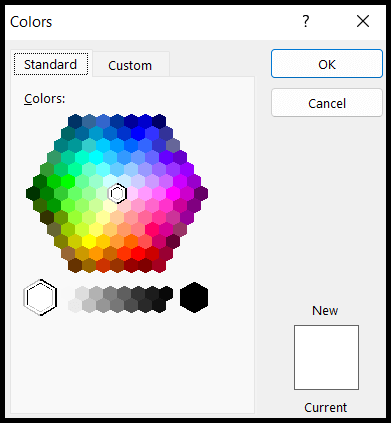
To remove a fill, press Alt, H, H, N for No Fill. For a colour that isn’t in the palette, press Alt, H, H, M to open More Colors, where the Custom tab lets you enter exact RGB values.
After you fill one range, select the next range and press F4 (or Ctrl + Y) to repeat the same fill without opening the palette again. This works only while the fill is the last thing you did.
For pattern or gradient fills, press Ctrl + 1 to open Format Cells and go to the Fill tab. The Alt sequences above are for Excel on Windows; on a Mac and in Excel for the web the keys differ, so test there before relying on them.
If a fill seems to have no effect, a conditional formatting rule on those cells is usually the cause, because conditional formats show on top of a manual fill. Check Home → Conditional Formatting → Manage Rules, and use conditional formatting yourself when the colour should change with the cell’s value.
Latest Video Tutorial – 10 Excel Keyboard Shortcuts (Probably YOU are NOT Using)
Many times, users want to make some cells easily visible to everyone, and for this, they prefer to highlight those cells by adding color to them using the fill color option. Fill color in Excel is used to fill the background of the cells with a color. Users can choose any color from the available ones and fill it in the cells.
Keyboard Shortcut to Fill Color in Excel
Alt → H → H
There is no direct keyboard shortcut to choose and fill a color in a cell, but you can still save some time by going directly to the Fill Color menu with this key sequence and selecting the color you need from there.
Steps to Fill Color Using Keyboard Shortcut
- First, select the cells where you want to fill the color.
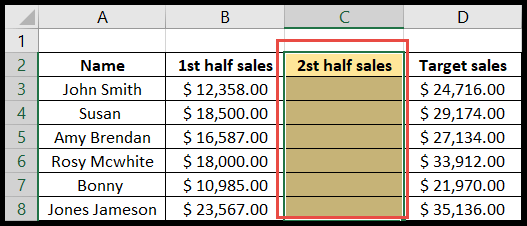
- After that, press the Alt → H → H keys in sequence, and you will get the Fill Color menu (with “Theme Colors” and “Standard Colors”) opened to choose the color.
- Now, using the Left, Right, Up and Down arrow keys, move the selection to the color you want to fill and then press Enter.

- Once you press Enter, you will get the selected cells filled with that color.
Points to Remember
- The color you add using the “Fill Color” option doesn’t change or go away unless you change or remove it yourself. So, if you want the color to change when the value changes, you have to use the “Conditional Formatting” option to fill the color.
- To remove the color from any cell, select the cell and press Alt → H → H → N (No Fill), and the color will be removed.
- To find more color options, press Alt → H → H → M and you will get the “Colors” dialog box opened.
Other Quick Ways to Fill Color
- Repeat the last color: after you fill one range, select another range and press F4 (or Ctrl + Y) to apply the same fill color again.
- Fill Color button: the paint bucket in Home ➜ Font remembers the last color you used, so one click on the bucket (not the arrow) applies that color.
- Format Cells: press Ctrl + 1, go to the Fill tab and choose a background color, a pattern or a gradient (Fill Effects).
- Mac: Excel for Mac doesn’t have the Alt key sequence, so use the Fill Color button on the Home tab or Command + 1 ➜ Fill.
Frequently Asked Questions
Why does the fill color not show on my cells?
A conditional formatting rule on the same cells shows on top of the fill color. Check Home ➜ Conditional Formatting ➜ Manage Rules and remove or change the rule.
Can I filter or sort by fill color?
Yes. Turn on the filter (Ctrl + Shift + L), open the drop-down of the column and use Filter by Color or Sort by Color.
Does fill color print?
Yes, unless Black and white is turned on in Page Setup ➜ Sheet. On a black-and-white printer, colors print as shades of gray.
After following all the steps, the colour is not visible on the online screen.