

Click the empty cell below a column of numbers, or to the right of a row, and press Alt + =. Excel inserts a SUM formula with the range it detects, such as =SUM(B2:B10); press Enter to accept it. On a Mac, use Cmd + Shift + T.
To total several columns at once, select the numbers together with the empty row below them and press Alt + =. Excel fills in every total without waiting for Enter. Include the empty column on the right as well and you get row totals and a grand total in one go.
When there are numbers both above and to the left, AutoSum picks the column above. If it picks the wrong range, drag over the right cells before pressing Enter. For an average, count, maximum or minimum instead, use the drop-down arrow on Home → AutoSum.
Check the highlighted range before you accept it. AutoSum stops at the first blank or text cell, so a gap in the column gives a total that is too low. Numbers stored as text are skipped by SUM too; convert them with Data → Text to Columns → Finish before totalling.
On a filtered list, the same shortcut inserts =SUBTOTAL(9,B2:B10) rather than SUM, so the total covers only the visible rows.
Latest Video Tutorial – 10 Excel Keyboard Shortcuts (Probably YOU are NOT Using)
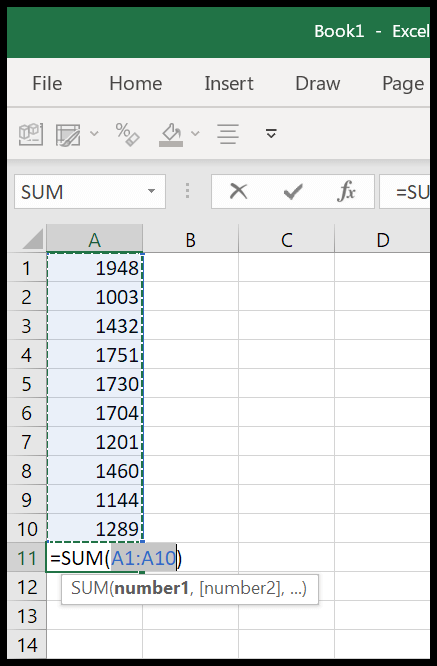
To perform an auto sum in Excel for the values you have in the cells above the active cell or the values in the cells from the left, you can use the shortcut key Alt + =. When you press this shortcut key, it inserts the SUM function in the active cell, referring to the range that’s above or on the left.
Alt + =
Now, as I said, you can also insert an AutoSum for the values that you have on the left side.

But if you have values on the left side as well as above the active cell, it will insert an AutoSum for the values above. There’s one more thing: when you press the shortcut key, it inserts the function, but you need to press Enter to get the result.
Before you press Enter, check the range that AutoSum has picked. It stops at the first blank cell or text cell, so if your data has a gap, select the right range with the mouse and then press Enter.
For example, with numbers in A1:A10 and the active cell in A11, Alt + = inserts this formula:
=SUM(A1:A10)
AutoSum for Many Rows or Columns at Once
You can add totals for several columns in one go. Select the data along with the empty row below it (or the empty column on the right), and press Alt + =. Excel adds a SUM formula in each empty cell. If you select the data with both the empty row and the empty column, you get the row totals, the column totals and the grand total together.
AutoSum Shortcut on a Mac
On a Mac, the AutoSum shortcut is Command + Shift + T. You can also use the AutoSum button on the Home tab (in the Editing group on Windows) or on the Formulas tab.
Other Functions with AutoSum
Click the small arrow next to the AutoSum button on the Home tab to insert Average, Count Numbers, Max or Min in the same way. They pick the range just like SUM.
Frequently Asked Questions
Why does AutoSum show 0?
Your numbers are probably stored as text. SUM skips text, so convert the cells to numbers (for example, with the error-checking menu or Data ➜ Text to Columns) and the total will update.
Does AutoSum work with filtered data?
When you use AutoSum right below a filtered list, Excel inserts SUBTOTAL(9, …) instead of SUM, so the total only adds the visible rows.
Can I use Alt + = in an Excel table?
Yes, but for tables it’s easier to turn on the Total Row (Table Design ➜ Total Row), which adds a total for each column that you can change to another function.