

Select the cells and press Alt, H, 6, one key after another, to increase the indent. Press Alt, H, 5 to decrease it. These are the key tips for Home → Increase Indent and Home → Decrease Indent.
Each press moves the text one level, so repeat the sequence to indent further. To set an exact level, open Format Cells with Ctrl + 1, go to the Alignment tab, set Horizontal to Left (Indent) and type a number in Indent.
Indenting a number that sits on the right by default moves it to the left side of the cell. To indent numbers in from the right edge, right-align them first with Alt, H, A, R, then press Alt, H, 6.
Use indent rather than typing spaces before the text. Leading spaces become part of the value, so VLOOKUP, MATCH and sorting treat " North" and "North" as different; an indent is formatting only. To strip spaces that are already there, use =TRIM(A2).
The Alt key tips work only in Windows Excel. On a Mac, use the Increase Indent and Decrease Indent buttons on the Home tab.
Latest Video Tutorial – 10 Excel Keyboard Shortcuts (Probably YOU are NOT Using)
In Excel, the indent is used to move the text away from the edge of the cell, increasing or decreasing the space on the left or the right. By default, Excel aligns text to the left and numbers to the right in the cells.
But by using Increase Indent, you can move the value to the right, and with Decrease Indent, you can move it back to the left in the cells.
Shortcut Keys to Add Indent in Excel
The keyboard shortcuts to increase or decrease indent are mentioned below:
Increase Indent
Alt → H → 6
Decrease Indent
Alt → H → 5
Steps to Add Indent Using Keyboard Shortcut
- First, select the cell or range of cells, where you want to add the indent.
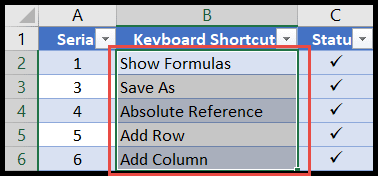
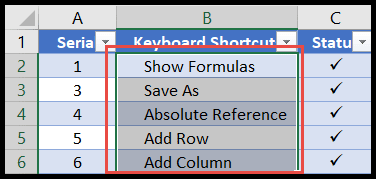
- After that, press the “Alt → H → 6” keys in sequence to move the text to the right in the cells.
- Or press the “Alt → H → 5” keys to move the alignment to the left in the cells.
- Press the indent shortcut keys multiple times to move the value to the required level.
Indent on a Mac
In Excel for Mac, press Control + Option + Tab to increase the indent and Control + Option + Shift + Tab to decrease it. You can also use the Increase Indent and Decrease Indent buttons on the Home tab.
Set an Exact Indent Level
Press Ctrl + 1 to open Format Cells, go to the Alignment tab, choose Left (Indent) or Right (Indent) in the Horizontal box, and enter the level in the Indent box. The indent level can go from 0 to 15, and each level is about the width of one character.
Note that when you use Increase Indent on a number (which is right-aligned), Excel changes it to left-aligned with an indent. To indent from the right side, choose Right (Indent) in Format Cells.
Frequently Asked Questions
Can I indent only the second line of text in a cell?
No. The indent applies to the whole cell. For a second line with extra space, add spaces after the line break (Alt + Enter).
Why does Alt → H → 6 not work?
Press the keys one after another, not together. Also make sure you are not editing the cell; press Enter or Esc first, as ribbon shortcuts don’t work in edit mode.
How do I remove the indent?
Press Alt → H → 5 until the value is back at the edge, or open Format Cells (Ctrl + 1) and set the Indent box to 0.