

Type the title in the top cell above your table, then go to Home → Cell Styles and click Title. If your data starts in row 1, right-click the row 1 header and choose Insert first to make room.
To centre the title over the table, select the title cell and the cells across the table’s width, press Ctrl + 1, and on the Alignment tab set Horizontal to Center Across Selection. It looks like Merge & Center without the selection and paste problems merged cells cause.
To change how every title looks, right-click Title in the Cell Styles gallery, choose Modify, click Format and set the font, size and border. Every cell that already uses the Title style updates at once.
If you need the title on every printed page, use Insert → Header & Footer for a page header, or Page Layout → Print Titles and set Rows to repeat at top to $1:$2 to repeat your title rows.
A modified Title style stays in that workbook only, so the next new file still gets the default look. Open the workbook you changed, then in the new file use Home → Cell Styles → Merge Styles to copy the style across, or save the changed workbook as a template.
In Excel, if you want to add a title in a worksheet, the best way to do this is to use the Cell Styles option, which has a pre-defined title style to apply to a cell. In this tutorial, we will learn to use it and to modify its formatting.
Steps to Add a Title in a Worksheet
- Enter a Value in a Cell which you want to convert into the title.
- Go to the Home Tab > Cell Styles.
- In the Cell Styles, hover to the “Title” style.
- Click on it to apply it to the cell.

As you can see in the above example, it will change the cell style for the selected cell into a title.
Modify the Formatting of the Cell
Instead of changing the format in the cell, you can modify the formatting of the title style. The benefit of this option is that you don’t need to apply the format again and again. Go to the Home > Cell Styles > Title, and then right-click on it.

Once you click on the modify, you get the “Style” dialog box.
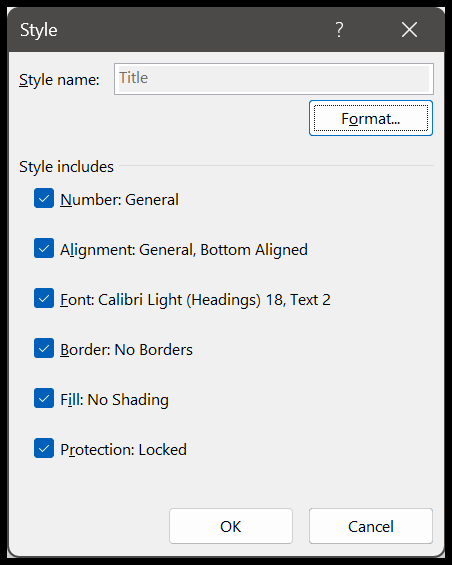
From this dialog box, you can check and un-check the formatting options you want to include in the style. And when you click on the “Format” button, it will get you the Format Cells dialog box, where you can change the formatting.
Center the Title Across Your Data
A title usually looks best sitting in the middle, above all the columns of your data, instead of stuck in one cell on the left. The quick way is “Merge & Center”: select the title cell and the cells across the width of your data, then go to the Home tab and click “Merge & Center”. Excel joins those cells into one and centers the title.
There is a cleaner way that does the same thing without actually merging the cells, which is better because merged cells can get in the way of sorting and selecting. Select the same range, press Ctrl + 1 to open Format Cells, go to the Alignment tab, open the “Horizontal” drop-down, and choose “Center Across Selection”. The title looks centered across the columns, but each cell stays separate underneath.
Frequently Asked Questions
Can I add a title that shows on every printed page?
Yes, but that is a header, not a cell title. Go to the Insert tab and click “Header & Footer”, or use Page Layout > Print Titles, and type your title in the header area. A header repeats at the top of every printed page, while a cell title with the “Title” style sits on the sheet itself.
Why use Center Across Selection instead of Merge & Center?
Both make the title look centered over your data, but merged cells can cause problems later. You can’t sort a range that contains merged cells, and selecting single columns gets awkward. “Center Across Selection” gives the same look while keeping every cell separate, so it’s the safer choice.
The title style looks different on another computer. Why?
Cell styles follow the workbook’s theme, so the “Title” style picks up the theme’s font and colors. If you change the theme (Page Layout > Themes) or open the file in a workbook with a different theme, the title’s font and color can change with it. Any changes you make with the Modify option are saved inside that one workbook.
Written by
Puneet Gogia
Microsoft MVP — Excel · Founder, Excel Champs
Twelve years of teaching Excel, and a decade before that using it as a data analyst. Every tutorial here is written from a file I actually built.