

Press F7, or go to Review → Spelling. Excel checks the sheet from the active cell, shows each word it doesn’t recognise with suggestions, and asks whether to continue from the top when it reaches the end.
Use Change or Change All to fix a word, Ignore Once or Ignore All to skip it, and Add to Dictionary for names and product codes. The custom dictionary is shared with Word and Outlook, so your additions carry over.
Spell check covers one sheet at a time. To check several, hold Ctrl and click the sheet tabs to group them, press F7, then right-click a tab and choose Ungroup Sheets before you carry on editing. To check only part of a sheet, select that range first.
By default, Excel skips words in capitals and words that contain numbers, and it never checks formulas. Change the first two settings, and the dictionary language (for example, English (United Kingdom) or English (United States)), under File → Options → Proofing.
Like Microsoft Word, Excel also has a spell check feature, but most Excel users don’t know about it or use it, as Excel is mainly used for numbers rather than text.
Spell check in Excel identifies misspelled words, and you can correct them right from the Spelling dialog box.
If we compare, spell check in Excel is not as advanced as in Word, where it checks grammar mistakes and underlines incorrect words as you type. But still, it is a good option for Excel users to run this check to find misspelled words and correct them.
Run Spell Check in Excel
- First, select the cell from where you want to start the spell check (select cell A1 to check the entire sheet from the top), or select a range to check only those cells.
- After that, go to the “Review” tab and click on the “Spelling” icon under the “Proofing” group on the ribbon or press F7 as a shortcut key for spell check.

- Once you click on “Spelling”, the spell check will start, and if it finds any misspelled word, the Spelling dialog box will open.
- The Spelling dialog box gives you suggestions for the misspelled word, and multiple actions to take for that word, like “Ignore Once, Change, Add to Dictionary” and many others.
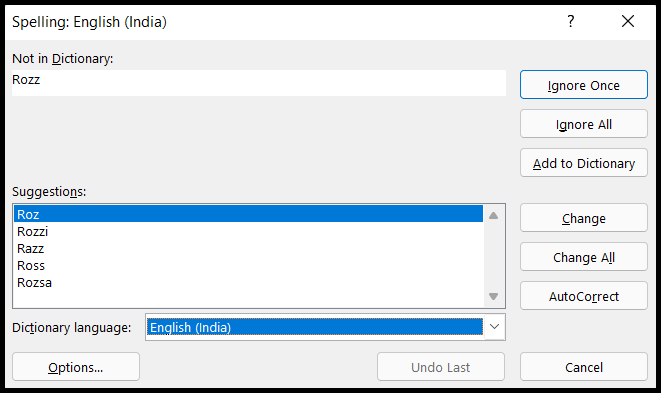
- Now, you can choose the suggestion and click on “Change” to update the misspelled word for this time only or you can click on “Ignore Once” to ignore that misspelled word this time only or can click on “Add to Dictionary” to add that word to the spell-check dictionary.
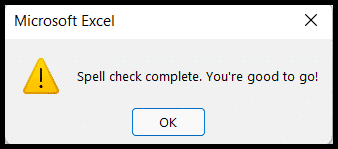
- Once you are done with all the misspelled words, it will show a message that the spell check is complete; click OK.
Spell Check Dialog Box Options
- Ignore Once: Ignores the word found as misspelled only once, which means if the same word repeats in the sheet, it will find that word as misspelled again.
- Ignore All: Ignores the word found as misspelled for all the instances and will not show that repeated word as misspelled again within the worksheet.
- Add to Dictionary: In case you need a word to be used as you entered it (mostly in the case of abbreviations), but spell check identifies that word as misspelled, you can add that word to the spell check dictionary so that whenever you use that word, spell check will not encounter it as misspelled.
- Change: Changes the misspelled word with the suggestion you select from the available suggestions for that misspelled word.
- Change All: Changes all the occurrences of the misspelled word with the suggestion you select.
- AutoCorrect: Changes the misspelled word with the suggestion and adds the pair to the AutoCorrect list, so every time you type that misspelled word, Excel corrects it automatically.
Change Spell Check Default Settings in Excel
Spell check in Excel has some default settings that users can change by doing the below steps:
- First, click on the “Options” button in the spell check dialog box.

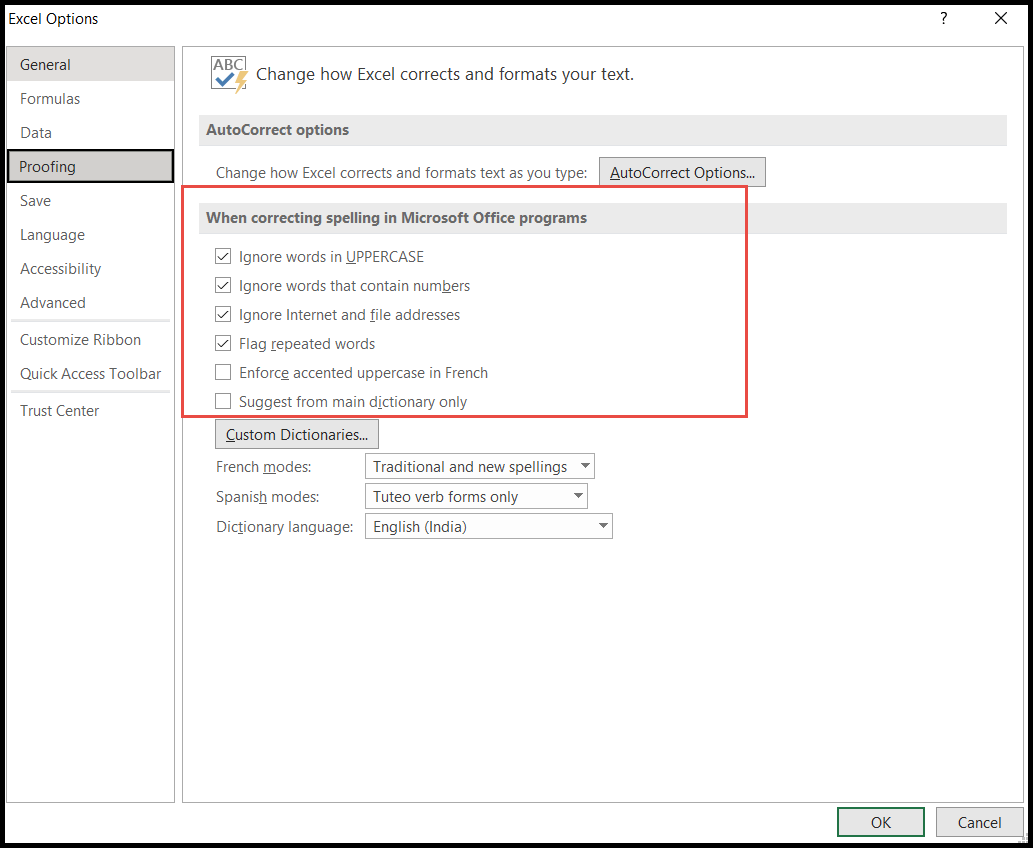
- Once you click on “Options”, it will open the “Excel Options” dialog box on the Proofing page, where you can change the default settings. You can also get there from File ➜ Options ➜ Proofing.
- Now, uncheck or check the default setting options you want to change and click OK.
Points to Remember
- Spell check identifies only the misspelled words.
- Spell check does not check words in uppercase and words that contain numbers until you uncheck these default options (“Ignore words in UPPERCASE” and “Ignore words that contain numbers”).
- Spell check does not check the words within Excel formulas.
- Spell check runs from left to right direction row by row.
- If you select a single cell other than A1 and run spell check, it starts from that cell, and when it reaches the end of the sheet, it asks if you want to continue checking at the beginning of the sheet.
- If you select multiple cells and run spell check, it will only run through those selected cells.
- Spell check shows you the misspelled words one by one, which means in whichever cell it finds a mistake, it opens the Spelling dialog box to take action on that mistake, and once you have done it, it shows you the next misspelled word, if any.
Spell Check Multiple Sheets at Once
Spell check works on the active sheet only. To check several sheets in one go, hold Ctrl and click the sheet tabs (or right-click a tab and choose Select All Sheets), then press F7. When you are done, right-click a tab and choose Ungroup Sheets, so your next edits don’t go to all the sheets.
Highlight Misspelled Words with VBA
Excel doesn’t underline misspelled words as you type. If you want to see all of them at once, the following macro uses Application.CheckSpelling to color every cell in the selection that has a misspelled word (it skips formulas):
Sub highlight_misspelled_cells()
    Dim cell As Range
    For Each cell In Selection
        If Not cell.HasFormula And VarType(cell.Value) = vbString Then
            If Not Application.CheckSpelling(Word:=cell.Value) Then
                cell.Interior.Color = RGB(255, 199, 206)
            End If
        End If
    Next cell
End Sub
Frequently Asked Questions
Can Excel check spelling automatically as I type?
No. Unlike Word, Excel has no red underline as you type. You need to run the spell check with F7, or use the AutoCorrect list to fix common typos automatically.
How do I change the spell check language?
In the Spelling dialog box, pick a language from the Dictionary language drop-down. It applies to that spell check and the next ones until you change it again.
How do I remove a word I added to the dictionary?
Go to File ➜ Options ➜ Proofing ➜ Custom Dictionaries, select the dictionary, click Edit Word List, and delete the word from there.

Written by
Puneet Gogia
Microsoft MVP — Excel · Founder, Excel Champs
Twelve years of teaching Excel, and a decade before that using it as a data analyst. Every tutorial here is written from a file I actually built.