

Select the cells, go to Home → Alignment → Orientation (the angled “ab” button) and pick Angle Counterclockwise, Angle Clockwise, Vertical Text, Rotate Text Up or Rotate Text Down. From the keyboard, Alt → H → F → Q opens the same list.
For an exact angle, press Ctrl + 1, open the Alignment tab and type a value from -90 to 90 in the Degrees box. Positive values tilt the text upwards and negative values tilt it downwards.
Rotated headers are the usual way to fit narrow columns: angle the header row at 45 or 90 degrees, then narrow the columns. Excel raises the row height automatically unless you’ve set it by hand.
Borders on angled cells tilt with the text, so a bordered header row can look skewed. If you need straight borders, use Rotate Text Up or Rotate Text Down (90 degrees) instead of an angle.
Chart axis labels are rotated separately: select the axis, press Ctrl + 1 and set Custom angle under Size & Properties → Alignment. In VBA, Range("A1:F1").Orientation = 45 sets the angle.
Working in Excel has always been fun. But sometimes it feels boring to see the same formats, text, fonts, and of course the same boring numbers.
Undoubtedly, you can change the appearance a little bit by using the Font option. But there is a lot more that you can do with the text direction and alignments.
This will not only change the look but, more importantly, save a lot of space. Scrolling down to the next pages is sometimes annoying, so you can fit the report on one page by playing around with the text orientation & alignment in a few simple steps.
- First, select the cell where you want to rotate the text. Here, we have selected the header row.

- Now, go to the Home tab and look for the Alignment group in the ribbon.

- Then, click on the Orientation button.

- Here you will get some default options in the drop-down.

- Now let’s try this one by one and see what happens to the text.

- In fact, you can get a sense from the symbol in front of each option about what is going to happen to your text.

This was about the default options you can use quickly with one click. Now, for those who do not like these options, there is something else you can choose.
- To get to the next level, again select the cells you wish to rotate and click on the last option “Format Cell Alignment”.

- After this, the Format Cells dialog box opens on the Alignment tab. You can also open it with Ctrl + 1.

- Towards the right, under Orientation, you can simply drag the red dot upwards and downwards to add a custom angle to your text (from -90 to 90 degrees).

- Moreover, you can manually enter an angle, positive or negative, next to “Degrees”.

Text Alignment
Here comes the interesting part. Until now, we have been talking about the text direction, or you can say orientation. The next thing you should know is text alignment. In other words, you can choose the location of the text, i.e. towards the center, right, left, top, or bottom of the cell. Let’s see how.
- First, select the cell→Home→Alignment→Orientation→Format Cell Alignment.

- Now you have 2 options, Horizontal & Vertical; click on the little drop-down arrow of each.

- Here you need to try every option and analyze what suits your report. Here’s a snapshot of what it looks like:

This might seem confusing, but it will surely be clearer once you try it.
Tip: Do not use a fixed set of arrangements for every report because the orientation and alignment depend on the length and type of text you have.
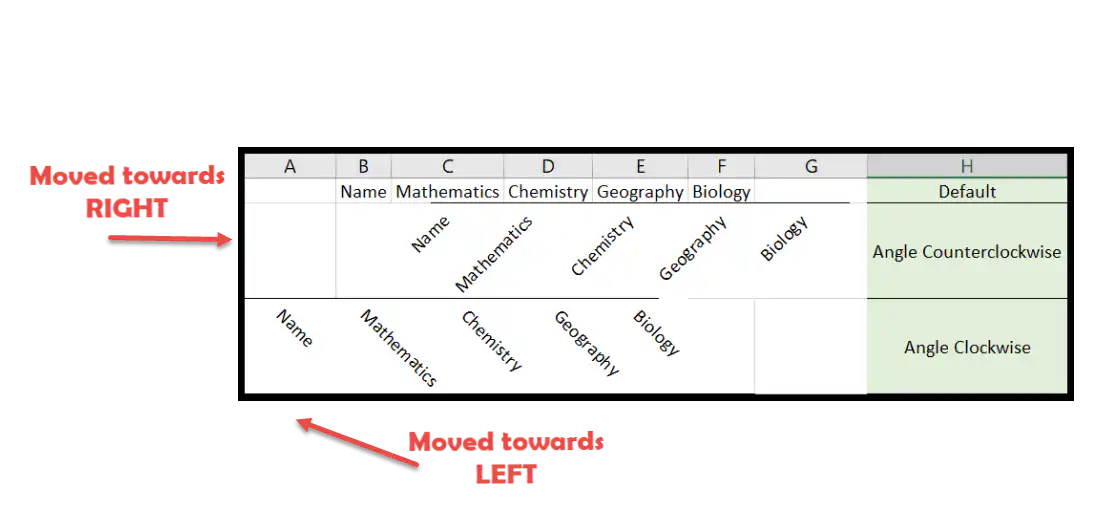
For example, the default text started in cells B1:F1. But you will notice that as soon as we used the orientation “Angle Counterclockwise”, the text moved towards the cell on the right, and towards the left with “Angle Clockwise”.
This could be a problem if our data started in column A, since the text would have gone out of the report view. So, you have to try every option and choose wisely according to your report and data type.
Other Ways to Rotate Text
- Keyboard shortcut: press Alt, H, F, Q one after another to open the Orientation menu, then pick an option with the arrow keys.
- Vertical Text: this option in the Orientation menu stacks the letters one below the other instead of turning them.
- Text box or shape: a cell can only turn text from -90 to 90 degrees. To turn it upside down or to any other angle, put it in a text box (Insert ➜ Text Box) and drag the round rotation handle on top of it.
And if you want to rotate text with VBA, use the Orientation property of the range. It takes an angle from -90 to 90, or xlVertical for vertical text:
Sub rotate_header_text()
    Range("B1:F1").Orientation = 45
End Sub
Frequently Asked Questions
How do I remove text rotation?
Select the cells, open Format Cells (Ctrl + 1), and on the Alignment tab, set Degrees to 0. Or click the option you applied in the Orientation menu again to turn it off.
Can I rotate text 180 degrees in a cell?
No. A cell only allows angles from -90 to 90 degrees. Use a text box or a shape when you need text upside down.
Why is my rotated text cut off?
The row is not tall enough for the angled text. Double-click the bottom border of the row header to AutoFit the row height, or turn on Wrap Text if the text is long.

Written by
Puneet Gogia
Microsoft MVP — Excel · Founder, Excel Champs
Twelve years of teaching Excel, and a decade before that using it as a data analyst. Every tutorial here is written from a file I actually built.